

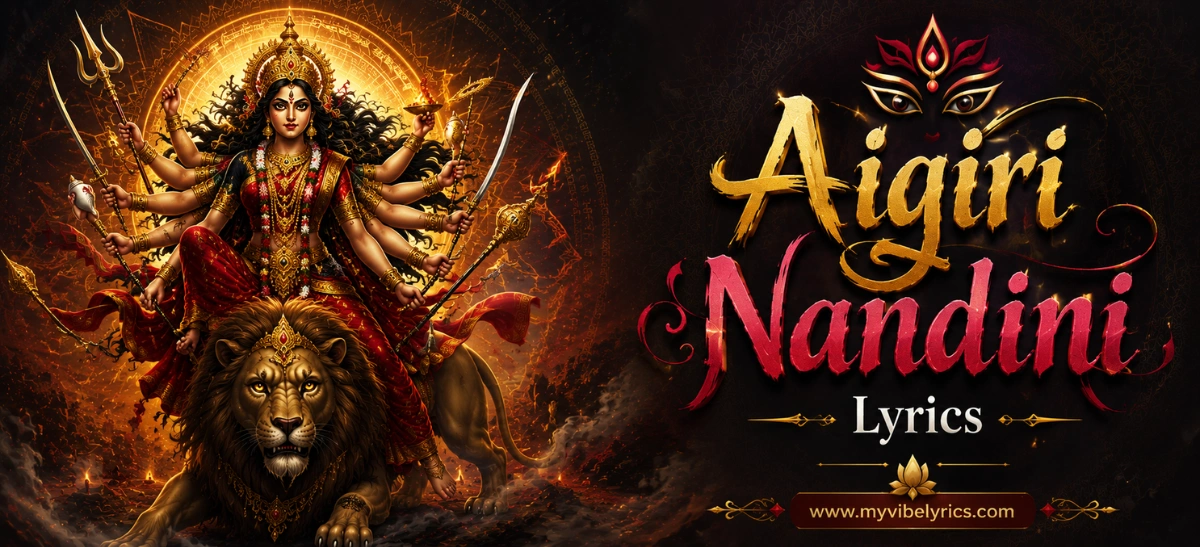
जब भी नवरात्रि आती है, या किसी मंदिर में Goddess Durga की आराधना होती है, तो एक स्तोत्र की गूँज सबसे पहले सुनाई देती है, “अयि गिरिनन्दिनि नन्दितमेदिनि…”। यही है Aigiri Nandini Lyrics In Sanskrit, एक ऐसा spiritual composition जो सदियों से भक्तों के ह्रदय में Maa Durga की शक्ति का अहसास कराता आया है।
यह सिर्फ एक गीत नहीं है। यह Mahishasura Mardini Stotram है, एक पूर्ण काव्य-रचना जिसमें देवी की असीम शक्ति, उनके युद्ध-कौशल, उनकी सौम्यता, और उनके भक्तों के प्रति करुणा का वर्णन 21 श्लोकों में किया गया है।
जो लोग Aigiri Nandini Lyrics in English या Aigiri Nandini Lyrics Sanskrit ढूंढते हैं, उनके लिए यह पूरा लेख एक comprehensive resource है, हर श्लोक के साथ उसका हिंदी transliteration और English translation।
स्तोत्र परिचय: एक नज़र में सब कुछ
| विवरण | जानकारी |
|---|---|
| स्तोत्र का नाम | महिषासुर मर्दिनि स्तोत्रम् (Mahishasura Mardini Stotram) |
| लोकप्रिय नाम | Aigiri Nandini / Ayigiri Nandini |
| रचयिता (Lyricist/Composer) | आदि शंकराचार्य (Adi Shankaracharya), परम्परागत मान्यता के अनुसार |
| भाषा | संस्कृत (Sanskrit) |
| देवता | माँ दुर्गा / माँ महिषासुर मर्दिनि |
| श्लोकों की संख्या | 21 |
| विधा (Genre) | Devotional Stotram / Spiritual Hymn |
| अवसर | नवरात्रि, दुर्गा पूजा, Durga Ashtami, दैनिक पाठ |
| Album/Film | कोई specific film नहीं, यह एक classical devotional stotram है; कई recorded versions उपलब्ध हैं (M.S. Subbulakshmi का version सबसे प्रसिद्ध) |
| प्रसिद्ध गायिका | M.S. Subbulakshmi (सबसे iconic recording) |
एक महत्वपूर्ण बात: इस स्तोत्र का कोई single “official” Bollywood film नहीं है। इसे classical devotional composition के रूप में जाना जाता है। M.S. Subbulakshmi की आवाज़ में यह 1970s से लेकर आज तक सबसे ज़्यादा सुनी जाने वाली recordings में से एक है।
Aigiri Nandini Lyrics In Sanskrit / Hindi, सम्पूर्ण पाठ
नीचे Mahishasura Mardini Stotram Lyrics के सभी 21 श्लोक मूल Sanskrit पाठ के साथ दिए गए हैं।
॥ महिषासुर मर्दिनि स्तोत्रम् ॥
श्लोक 1
अयि गिरिनन्दिनि नन्दितमेदिनि विश्वविनोदिनि नन्दिनुते
गिरिवरविन्ध्यशिरोऽधिनिवासिनि विष्णुविलासिनि जिष्णुनुते।
भगवति हे शितिकण्ठकुटुम्बिनि भूरिकुटुम्बिनि भूरिकृते
जय जय हे महिषासुरमर्दिनि रम्यकपर्दिनि शैलसुते॥
श्लोक 2
सुरवरवर्षिणि दुर्धरधर्षिणि दुर्मुखमर्षिणि हर्षरते
त्रिभुवनपोषिणि शङ्करतोषिणि किल्बिषमोषिणि घोषरते
दनुजनिरोषिणि दितिसुतरोषिणि दुर्मदशोषिणि सिन्धुसुते
जय जय हे महिषासुरमर्दिनि रम्यकपर्दिनि शैलसुते॥
श्लोक 3
अयि जगदम्ब मदम्ब कदम्ब वनप्रियवासिनि हासरते
शिखरि शिरोमणि तुङ्गहिमलय शृङ्गनिजालय मध्यगते।
मधुमधुरे मधुकैटभगञ्जिनि कैटभभञ्जिनि रासरते
जय जय हे महिषासुरमर्दिनि रम्यकपर्दिनि शैलसुते॥
श्लोक 4
अयि शतखण्ड विखण्डितरुण्ड वितुण्डितशुण्द गजाधिपते
रिपुगजगण्ड विदारणचण्ड पराक्रमशुण्ड मृगाधिपते।
निजभुजदण्ड निपातितखण्ड विपातितमुण्ड भटाधिपते
जय जय हे महिषासुरमर्दिनि रम्यकपर्दिनि शैलसुते॥
श्लोक 5
अयि रणदुर्मद शत्रुवधोदित दुर्धरनिर्जर शक्तिभृते
चतुरविचार धुरीणमहाशिव दूतकृत प्रमथाधिपते।
दुरितदुरीह दुराशयदुर्मति दानवदुत कृतान्तमते
जय जय हे महिषासुरमर्दिनि रम्यकपर्दिनि शैलसुते॥
श्लोक 6
अयि शरणागत वैरिवधुवर वीरवराभय दायकरे
त्रिभुवनमस्तक शुलविरोधि शिरोऽधिकृतामल शुलकरे।
दुमिदुमितामर धुन्दुभिनादमहोमुखरीकृत दिङ्मकरे
जय जय हे महिषासुरमर्दिनि रम्यकपर्दिनि शैलसुते॥
श्लोक 7
अयि निजहुङ्कृति मात्रनिराकृत धूम्रविलोचन धूम्रशते
समरविशोषित शोणितबीज समुद्भवशोणित बीजलते।
शिवशिवशुम्भ निशुम्भमहाहव तर्पितभूत पिशाचरते
जय जय हे महिषासुरमर्दिनि रम्यकपर्दिनि शैलसुते॥
श्लोक 8
धनुरनुषङ्ग रणक्षणसङ्ग परिस्फुरदङ्ग नटत्कटके
कनकपिशङ्ग पृषत्कनिषङ्ग रसद्भटशृङ्ग हताबटुके।
कृतचतुरङ्ग बलक्षितिरङ्ग घटद्बहुरङ्ग रटद्बटुके
जय जय हे महिषासुरमर्दिनि रम्यकपर्दिनि शैलसुते॥
श्लोक 9
सुरललना ततथेयि तथेयि कृताभिनयोदर नृत्यरते
कृत कुकुथः कुकुथो गडदादिकताल कुतूहल गानरते।
धुधुकुट धुक्कुट धिंधिमित ध्वनि धीर मृदंग निनादरते
जय जय हे महिषासुरमर्दिनि रम्यकपर्दिनि शैलसुते॥
श्लोक 10
जय जय जप्य जयेजयशब्द परस्तुति तत्परविश्वनुते
झणझणझिञ्झिमि झिङ्कृत नूपुरशिञ्जितमोहित भूतपते।
नटित नटार्ध नटी नट नायक नाटितनाट्य सुगानरते
जय जय हे महिषासुरमर्दिनि रम्यकपर्दिनि शैलसुते॥
श्लोक 11
अयि सुमनःसुमनःसुमनः सुमनःसुमनोहरकान्तियुते
श्रितरजनी रजनीरजनी रजनीरजनी करवक्त्रवृते।
सुनयनविभ्रमर भ्रमरभ्रमर भ्रमरभ्रमराधिपते
जय जय हे महिषासुरमर्दिनि रम्यकपर्दिनि शैलसुते॥
श्लोक 12
सहितमहाहव मल्लमतल्लिक मल्लितरल्लक मल्लरते
विरचितवल्लिक पल्लिकमल्लिक झिल्लिकभिल्लिक वर्गवृते।
शितकृतफुल्ल समुल्लसितारुण तल्लजपल्लव सल्ललिते
जय जय हे महिषासुरमर्दिनि रम्यकपर्दिनि शैलसुते॥
श्लोक 13
अविरलगण्ड गलन्मदमेदुर मत्तमतङ्ग जराजपते
त्रिभुवनभुषण भूतकलानिधि रूपपयोनिधि राजसुते।
अयि सुदतीजन लालसमानस मोहन मन्मथराजसुते
जय जय हे महिषासुरमर्दिनि रम्यकपर्दिनि शैलसुते॥
श्लोक 14
कमलदलामल कोमलकान्ति कलाकलितामल भाललते
सकलविलास कलानिलयक्रम केलिचलत्कल हंसकुले।
अलिकुलसङ्कुल कुवलयमण्डल मौलिमिलद्बकुलालिकुले
जय जय हे महिषासुरमर्दिनि रम्यकपर्दिनि शैलसुते॥
श्लोक 15
करमुरलीरव वीजितकूजित लज्जितकोकिल मञ्जुमते
मिलितपुलिन्द मनोहरगुञ्जित रञ्जितशैल निकुञ्जगते।
निजगणभूत महाशबरीगण सद्गुणसम्भृत केलितले
जय जय हे महिषासुरमर्दिनि रम्यकपर्दिनि शैलसुते॥
श्लोक 16
कटितटपीत दुकूलविचित्र मयुखतिरस्कृत चन्द्ररुचे
प्रणतसुरासुर मौलिमणिस्फुर दंशुलसन्नख चन्द्ररुचे
जितकनकाचल मौलिमदोर्जित निर्भरकुञ्जर कुम्भकुचे
जय जय हे महिषासुरमर्दिनि रम्यकपर्दिनि शैलसुते॥
श्लोक 17
विजितसहस्रकरैक सहस्रकरैक सहस्रकरैकनुते
कृतसुरतारक सङ्गरतारक सङ्गरतारक सूनुसुते।
सुरथसमाधि समानसमाधि समाधिसमाधि सुजातरते।
जय जय हे महिषासुरमर्दिनि रम्यकपर्दिनि शैलसुते॥
श्लोक 18
पदकमलं करुणानिलये वरिवस्यति योऽनुदिनं सुशिवे
अयि कमले कमलानिलये कमलानिलयः स कथं न भवेत्।
तव पदमेव परम्पदमित्यनुशीलयतो मम किं न शिवे
जय जय हे महिषासुरमर्दिनि रम्यकपर्दिनि शैलसुते॥
श्लोक 19
कनकलसत्कलसिन्धुजलैरनुषिञ्चति तेगुणरङ्गभुवम्
भजति स किं न शचीकुचकुम्भतटीपरिरम्भसुखानुभवम्।
तव चरणं शरणं करवाणि नतामरवाणि निवासि शिवम्
जय जय हे महिषासुरमर्दिनि रम्यकपर्दिनि शैलसुते॥
श्लोक 20
तव विमलेन्दुकुलं वदनेन्दुमलं सकलं ननु कूलयते
किमु पुरुहूतपुरीन्दु मुखी सुमुखीभिरसौ विमुखीक्रियते।
मम तु मतं शिवनामधने भवती कृपया किमुत क्रियते
जय जय हे महिषासुरमर्दिनि रम्यकपर्दिनि शैलसुते॥
श्लोक 21
अयि मयि दीन दयालुतया कृपयैव त्वया भवितव्यमुमे
अयि जगतो जननी कृपयासि यथासि तथानुमितासिरते।
यदुचितमत्र भवत्युररीकुरुतादुरुतापमपाकुरुते
जय जय हे महिषासुरमर्दिनि रम्यकपर्दिनि शैलसुते॥
Disclaimer
ये lyrics Mahishasura Mardini Stotram / Aigiri Nandini के original Sanskrit text पर आधारित हैं। यह एक पारंपरिक संस्कृत स्तोत्र है जो सार्वजनिक domain में है। Translation और transliteration शैक्षणिक और भक्ति उद्देश्यों के लिए प्रदान की गई है।
Aigiri Nandini Lyrics In English, Transliteration and Translation
॥ Mahishasura Mardini Stotram ॥
Verse 1
Transliteration:
Ayi girinandini nanditamedini vishwavinodini nandinute
Girivaravindhyashiro’dhinivasini vishnuvilasini jishnunute ।
Bhagavati he shitikanthakutumbini bhurikutumbini bhurikrite
Jaya jaya he Mahishasura-mardini ramyakapardini shailasute ।।
English Translation: O daughter of the mountains, who delights the earth and brings joy to the world, praised by Nandi. Who dwells on the great peak of Vindhya, who delights Vishnu, praised by Indra. O Goddess, wife of the blue-throated Lord (Shiva), of great family, creator of abundance. Victory, victory to you, O slayer of Mahishasura, beautiful-haired daughter of the mountain!
Verse 2
Transliteration:
Suravaravarsini durdharadharsini durmukhamarsini harsharate
Tribhuvanaposhini shankaratoshini kilbishamoshini ghosharate ।
Danujanirosini ditisutatoshini durmadashoshini sindhusute
Jaya jaya he Mahishasura-mardini ramyakapardini shailasute ।।
English Translation: Who showers blessings on the greatest of gods, who crushes the hardest arrogance, who endures the wicked-faced, who delights in joy. Who nurtures the three worlds, who pleases Shankara, who removes sins, who rejoices in divine sound. Who angers the Danavas, who fills the sons of Diti with rage, who dries up wicked pride, daughter of the ocean. Victory, victory to you, O slayer of Mahishasura, beautiful-haired daughter of the mountain!
Verse 3
Transliteration:
Ayi jagadamba madamba kadamba vanapriyavasini hasarate
Shikhari shiromani tungahimalaya shringanijaalaya madhyagate ।
Madhumadhure madhukaitabhaganjini kaitabhabhanjini rasarate
Jaya jaya he Mahishasura-mardini ramyakapardini shailasute ।।
English Translation: O Mother of the Universe, my Mother, who loves to dwell in forests of Kadamba trees, who delights in laughter. Who dwells in the high peaks of the Himalayas, the crown jewel of mountains, residing in the lofty abode. Who is sweet like honey, who destroyed the demon Madhu and Kaitabha, who revels in the cosmic dance. Victory, victory to you, O slayer of Mahishasura, beautiful-haired daughter of the mountain!
Verse 4
Transliteration:
Ayi shata-khanda vikhanditarunda vitunditashunda gajadhipate
Ripugajaganda vidaranachanda parakramashunda mrigadhipate ।
Nijabhujadanda nipatitakhanda vipatitamunda bhathadhipate
Jaya jaya he Mahishasura-mardini ramyakapardini shailasute ।।
English Translation: O Goddess, who cuts the heads of enemies into hundreds of pieces, who smashes the trunks of mighty elephants, Lord of elephants. Who fiercely tears apart the cheeks of enemy elephants, whose valor is like a great elephant’s trunk, Lord of lions. Who strikes down pieces of enemies with the rod of her own arms, who fells the heads of warriors, commander of armies. Victory, victory to you, O slayer of Mahishasura, beautiful-haired daughter of the mountain!
Verse 5
Transliteration:
Ayi ranadurumada shatruvadhodita durdharanirgara shaktibhrite
Chaturavichara dhurinamahashiva dutakrita pramathaadhipate ।
Duritadureedha durashayadurmati danavaduta kritantamate
Jaya jaya he Mahishasura-mardini ramyakapardini shailasute ।।
English Translation: O Goddess, wielder of incomprehensible power that rises to slay battle-drunk enemies. Who commands the wise deliberations of Shiva’s great messengers, Lord of the Pramathas. Who is the instrument of death for sinful, ill-intentioned, wicked-minded demons. Victory, victory to you, O slayer of Mahishasura, beautiful-haired daughter of the mountain!
Verse 6
Transliteration:
Ayi sharanagata vairivadhu-vara viravara-abhaya dayakare
Tribhuvanasthaka shulavirodhi shiro’dhikritamala shulakare ।
Dumidumitamara dhundubhinaadamaho mukharikrita dinmakare
Jaya jaya he Mahishasura-mardini ramyakapardini shailasute ।।
English Translation: O Goddess, who grants refuge and protection even to the wives and kin of enemies seeking shelter. Who holds the pure trident that opposes evil across the three worlds. Who fills all the directions with the resonant sound of the divine war-drums. Victory, victory to you, O slayer of Mahishasura, beautiful-haired daughter of the mountain!
Verse 7
Transliteration:
Ayi nijahunkruti matranirakrita dhumravilochana dhumrashathe
Samara-vishoshita shonitabija samudbhava-shonita bija-late ।
Shivasivashumbha nishumbhamamahava tarpitabhuta pishacharate
Jaya jaya he Mahishasura-mardini ramyakapardini shailasute ।।
English Translation: O Goddess, who destroyed the demon Dhumravilochana with just a single humkara (war-cry). Who dried up the blood-seed (Raktabija) born from the battlefield, stopping the flow of the blood-vine. Who delighted the spirits and ghosts by the great battle and slaying of Shumbha and Nishumbha. Victory, victory to you, O slayer of Mahishasura, beautiful-haired daughter of the mountain!
Verse 8
Transliteration:
Dhanuranushan gana-kshana-sanga parisfuradanga natatwatakate
Kanakapishan ga-prishatkanishanga rasad-bhatashrunga hatawatuke ।
Kritachaturanga balakshitirangha ghatad-bahurangha ratadwatuke
Jaya jaya he Mahishasura-mardini ramyakapardini shailasute ।।
English Translation: O Goddess, whose ornaments flash with the bow and arrows in the battle-moment, limbs shining like lightning. Whose golden quiver holds rushing arrows, whose warrior-heroes’ war cries fill the battlefield. Who assembles the four-fold army across the great battlefield, filling it with manifold colorful activity. Victory, victory to you, O slayer of Mahishasura, beautiful-haired daughter of the mountain!
Verse 9
Transliteration:
Suralalana tathatheyi tathatheyi kritabhinayodara nrityarate
Krita kukutah kukutho gadadadi-tala kutuhala ganarate ।
Dhudhukuta dhukkuta dhimdhimita dhvani dhira mridanga ninadarate
Jaya jaya he Mahishasura-mardini ramyakapardini shailasute ।।
English Translation: O Goddess, before whom the celestial damsels perform expressive dances to the rhythm of “tatatheyi tatatheyi”. Who delights in the music with complex rhythmic patterns played with great curiosity. Who revels in the deep resonant sound of the mridanga drum going “dhudhukuta dhukkuta”. Victory, victory to you, O slayer of Mahishasura, beautiful-haired daughter of the mountain!
Verse 10
Transliteration:
Jaya jaya japya jayejayashabda parastutitatpara vishvanute
Jhana-jhana-jinjhimi jinkrita nupura-shinjita-mohita bhutapate ।
Natita natardha nati nata nayaka natita-natya suganarate
Jaya jaya he Mahishasura-mardini ramyakapardini shailasute ।।
English Translation: O Goddess, praised by the whole world with victory-chants of “jaya jaya”. Whose anklets ring with “jhana jhana jhinjhimi” enchanting the Lord of all beings. Who is the dancer, the half-dancer, the actress, the actor, the leader, performer of perfect divine drama. Victory, victory to you, O slayer of Mahishasura, beautiful-haired daughter of the mountain!
Verse 11
Transliteration:
Ayi sumanah-sumanah-sumanah sumanah-sumanohara-kantiyute
Shrita-rajani rajanirajani rajanirajani karavaktravrite ।
Sunayanavibrhamara bhramarabhrhamara bhramarabhramaradhipate
Jaya jaya he Mahishasura-mardini ramyakapardini shailasute ।।
English Translation: O Goddess, adorned with the captivating radiance of flowers (sumanah = good-minded / flower, used as a beautiful double meaning). Whose lotus-like face is surrounded by bees like the night-lotus surrounded by night. Whose beautiful eyes move like the lord of the bees. Victory, victory to you, O slayer of Mahishasura, beautiful-haired daughter of the mountain!
Verse 12
Transliteration:
Sahitamahahava mallamatallika malitarallaka mallarate
Virachitavallika pallikamallika jhillikabhillika vargavrite ।
Shitakritaphulla samullasitaruna tallajapallava sallalite
Jaya jaya he Mahishasura-mardini ramyakapardini shailasute ।।
English Translation: O Goddess, who delights in the great wrestling battles between powerful warrior women. Who is surrounded by groups of tribal women, forest women, grassland women, village women. Whose tender red sprouts glow like freshly bloomed flowers shining brilliantly. Victory, victory to you, O slayer of Mahishasura, beautiful-haired daughter of the mountain!
Verse 13
Transliteration:
Avirala-ganda galanmada-medura matta-matanga jarajapate
Tribhuvanabhushana bhutakalanidhirupapayonidhi rajasute ।
Ayi sudatijana lalasamanasa mohana manmatha-rajasute
Jaya jaya he Mahishasura-mardini ramyakapardini shailasute ।।
English Translation: O Goddess, seated on a mad elephant exuding rut, cheeks continuously dripping with fragrant fluid. Ornament of the three worlds, treasure of arts and existence, ocean of beauty, daughter of a king. O Goddess, whose mind is desired by beautiful fair-toothed ones, daughter of the king of Kamadeva. Victory, victory to you, O slayer of Mahishasura, beautiful-haired daughter of the mountain!
Verse 14
Transliteration:
Kamaladalamala komalakanti kalakaliamala bhalalatae
Sakalavilasa kalanilayakrama kelichalatkala hamsavule ।
Alikula-sankula kuvalayamandala maulimiladbakula-alikule
Jaya jaya he Mahishasura-mardini ramyakapardini shailasute ।।
English Translation: O Goddess, whose forehead is pure like the petal of a lotus, tender and radiant, adorned with arts. Who is the seat of all joyful arts, followed by a flock of gracefully moving swans. Whose crown is surrounded by swarms of bees gathered around a circle of blue lotus flowers. Victory, victory to you, O slayer of Mahishasura, beautiful-haired daughter of the mountain!
Verse 15
Transliteration:
Karamuraleerava veejitakoojita lajjita-kokila manju-mate
Milita-pulinda manoharagunji ranjitashaila nikunjagate ।
Nijagana-bhuuta mahaa-shabari-gana sadgunasambhrita kelitale
Jaya jaya he Mahishasura-mardini ramyakapardini shailasute ।।
English Translation: O Goddess, whose hand-flute’s music makes the cuckoo itself feel ashamed for its sweet sound. Who moves into the delightful forest-groves of mountains, charmed by the humming of the Pulinda tribe. Who sports in the company of great Shabari women of her own divine retinue, filled with good qualities. Victory, victory to you, O slayer of Mahishasura, beautiful-haired daughter of the mountain!
Verse 16
Transliteration:
Katitata-pita dukula-vichitra mayukha-tiraskrita chandraruche
Pranata-surasura maulimani-sphura damshulasannakha chandraruche ।
Jitakanakachala maulimadorjita nirbharakunja-ra kumbhakuche
Jaya jaya he Mahishasura-mardini ramyakapardini shailasute ।।
English Translation: O Goddess, whose yellow silk cloth on the waist outshines even the brilliance of the moon. Whose nails gleam like the moon, adorned with the crown-gems of prostrating gods and demons. Whose bosom surpasses the golden mountain peak in fullness and firmness. Victory, victory to you, O slayer of Mahishasura, beautiful-haired daughter of the mountain!
Verse 17
Transliteration:
Vijita-sahasrakaraika sahasra-karaika sahasra-karaika-nute
Krita-surataraka sangara-taraka sangara-taraka suunu-sute ।
Suratha-samadhi samana-samadhi samadhi-samadhi sujaatarate
Jaya jaya he Mahishasura-mardini ramyakapardini shailasute ।।
English Translation: O Goddess, praised by one, thousand, and thousand thousands together. Who protected the gods by slaying Tarakasura, daughter of the one who protects in the battlefield. Who is rejoiced in supreme meditation, equal to perfect meditation, born of perfect meditation. Victory, victory to you, O slayer of Mahishasura, beautiful-haired daughter of the mountain!
Verse 18
Transliteration:
Pada-kamalam karunanilaye varivasayati yo’nudinam sushive
Ayi kamale kamala-nilaye kamalaa-nilayah sa katham na bhavet ।
Tava padameva param-padamityanu-shilayato mama kim na shive
Jaya jaya he Mahishasura-mardini ramyakapardini shailasute ।।
English Translation: O Goddess, abode of compassion, one who worships your lotus feet daily, O auspicious one. O Lakshmi, dwelling in the lotus, how can that devotee not attain the abode of the lotus (Vaikuntha)?. O auspicious one, what is it that I lack when I constantly meditate that your feet alone are the supreme goal?. Victory, victory to you, O slayer of Mahishasura, beautiful-haired daughter of the mountain!
Verse 19
Transliteration:
Kanakalasat-kalasindhu jalairanu-shinchhati te guna-ranga-bhuvam
Bhajati sa kim na shachi-kucha-kumbha-tati-parirambha-sukhaanu-bhavam ।
Tava charanam sharanam karavani natamara-vani nivaasi shivam
Jaya jaya he Mahishasura-mardini ramyakapardini shailasute ।।
English Translation: One who worships your divine stage of virtues with waters from the golden ocean. Does such a devotee not attain the bliss of embracing Indrani’s graceful form?. I take refuge at your feet, O Goddess who resides in the praises of the bowing celestials. Victory, victory to you, O slayer of Mahishasura, beautiful-haired daughter of the mountain!
Verse 20
Transliteration:
Tava vimalendu-kulam vadanendumalam sakalam nanu kulayate
Kimu puruhuta-purindumukhi sumukhee-bhirasau vimukheekruyate ।
Mama tu matam shivanamdhane bhavati kripaya kimuta kriyate
Jaya jaya he Mahishasura-mardini ramyakapardini shailasute ।।
English Translation: Your pure moon-like lineage is indeed comparable to your moon-like blemishless face. How could the beautiful-faced women of Indra’s city turn their faces away from such radiance?. For me, your name is Shiva (auspiciousness itself), O Goddess, what indeed is impossible with your grace?. Victory, victory to you, O slayer of Mahishasura, beautiful-haired daughter of the mountain!
Verse 21
Transliteration:
Ayi mayi deena dayalutaya kripayaiva tvaya bhavitavyamume
Ayi jagato janani kripayasi yathaasi tathanumiitaasi-rate ।
Yaducitam atra bhavatyururee-kurutaadurutapam-apaakurute
Jaya jaya he Mahishasura-mardini ramyakapardini shailasute ।।
English Translation: O Uma, you must surely bestow your compassion on me, this humble soul. O Mother of the Universe, you are as compassionate as you are, and that is how I perceive you. Whatever is appropriate here, please accept it, O Goddess, and remove this great suffering. Victory, victory to you, O slayer of Mahishasura, beautiful-haired daughter of the mountain!
संगीत रचना और स्वर-प्रदर्शन
Aigiri Nandini Lyrics Sanskrit की सबसे बड़ी विशेषता इसकी ध्वनि-संरचना है। यह स्तोत्र अतिधृति छंद में रचित है, एक ऐसा meter जो बेहद तेज़, rhythmic और percussion-friendly है।
हर श्लोक की ending में दोहराई जाने वाली refrain.
“जय जय हे महिषासुरमर्दिनि रम्यकपर्दिनि शैलसुते”
यह सिर्फ एक refrain नहीं है। यह हर श्लोक के बाद एक anchor statement है जो श्रोता को देवी की केंद्रीय पहचान, “महिषासुर को मारने वाली, सुंदर जटाओं वाली, पर्वत-पुत्री”, से जोड़े रखता है।
M.S. Subbulakshmi की recording (जो All India Radio पर 1970s से प्रसारित होती है) इस स्तोत्र की सबसे प्रामाणिक और व्यापक रूप से सुनी जाने वाली version मानी जाती है। उनकी आवाज़ में Carnatic classical training और bhakti दोनों का अद्भुत संगम है।
श्लोक 9 विशेष रूप से उल्लेखनीय है, “ततथेयि तथेयि” और “धुधुकुट धुक्कुट” जैसी onomatopoeic expressions से यह पूरी तरह percussion के साथ गाने के लिए design किया गया है। यह Sanskrit poetry की उस tradition का हिस्सा है जहाँ शब्द खुद ध्वनि बन जाते हैं।
क्यों Mahishasura Mardini Stotram Lyrics इतनी शक्तिशाली हैं, एक genuine analysis
- Linguistic Density: हर श्लोक में 8-10 विशेषण एक ही लय में बंधे हैं, यह memorization को आसान और recitation को deeply meditative बनाता है।
- Martial + Aesthetic Duality: श्लोक 4-7 में युद्ध का raw, graphic वर्णन है, जबकि श्लोक 11-15 में देवी की सौंदर्य-महिमा है। यह contrast intentional है, Shakti की पूर्णता दर्शाने के लिए।
- Final Surrender (श्लोक 18-21): स्तोत्र का समापन pure devotion और surrender में होता है। यह transition, warrior goddess से compassionate mother की ओर, spiritually profound है।
? FAQs About Aigiri Nandini Lyrics
Q1. Aigiri Nandini किसने लिखी?
परम्परागत मान्यता के अनुसार आदि शंकराचार्य (8वीं-9वीं सदी) द्वारा रचित।
Q2. Aigiri Nandini और Mahishasura Mardini Stotram में क्या अंतर है?
कोई अंतर नहीं। दोनों एक ही हैं। “Aigiri Nandini” पहले दो शब्द हैं, पूरे स्तोत्र का नाम Mahishasura Mardini Stotram है और इसके lyrics को Mahishasura Mardini Stotram Lyrics के नाम से भी search किया जाता है।
Q3. इस स्तोत्र में कितने श्लोक हैं?
कुल 21 श्लोक हैं।
Q4. Aigiri Nandini का अर्थ क्या है?
“हे पर्वत-पुत्री!” — Goddess Parvati/Durga का सम्बोधन, जो पर्वतराज Himalaya की पुत्री हैं।
Q5. क्या Aigiri Nandini किसी Bollywood film का हिस्सा है?
नहीं, यह कोई film song नहीं है। यह एक classical Sanskrit devotional stotram है।
Q6. Aigiri Nandini किस भाषा में है?
Sanskrit में।
Q7. क्या इसे daily पाठ के रूप में पढ़ सकते हैं?
हाँ। नवरात्रि, Durga Ashtami, शुक्रवार या किसी भी दिन सुबह पढ़ सकते हैं।
Q8. Aigiri Nandini का सबसे अच्छा recorded version कौन सा है?
M.S. Subbulakshmi का version सबसे प्रामाणिक माना जाता है।

 If You Liked The Lyrics Of This Songs, Check Out Also These Lyrics As Well:
- Surya Chalisa Lyrics
- लेडीज कीर्तन भजन लिरिक्स
- Thali Bhar Ke Layi Re Khichdo Lyrics
- Wo Shahre Mohabbat Jahan Mustafa Hai Lyrics
- Chandrachooda Shiva Shankara Lyrics
- Vrindavan Me Hukum Chale Barsane Wali Ka Lyrics
- Kya Bataun Ke Kya Madina Hai Lyrics
- Sab Kuch Sarkar Tumhi Se Hai Lyrics
- Tulsi Vivah Mangalashtak
- Kaal Bhairav Ashtakam Lyrics in Hindi
- Aditya Hridaya Stotra Lyrics
- Shiv Tandav Stotram Lyrics in English
- Pranamya Shirasa Devam Lyrics
- Shri Swami Samarth Aarti Lyrics
- Durga Saptashloki Lyrics in Tamil