

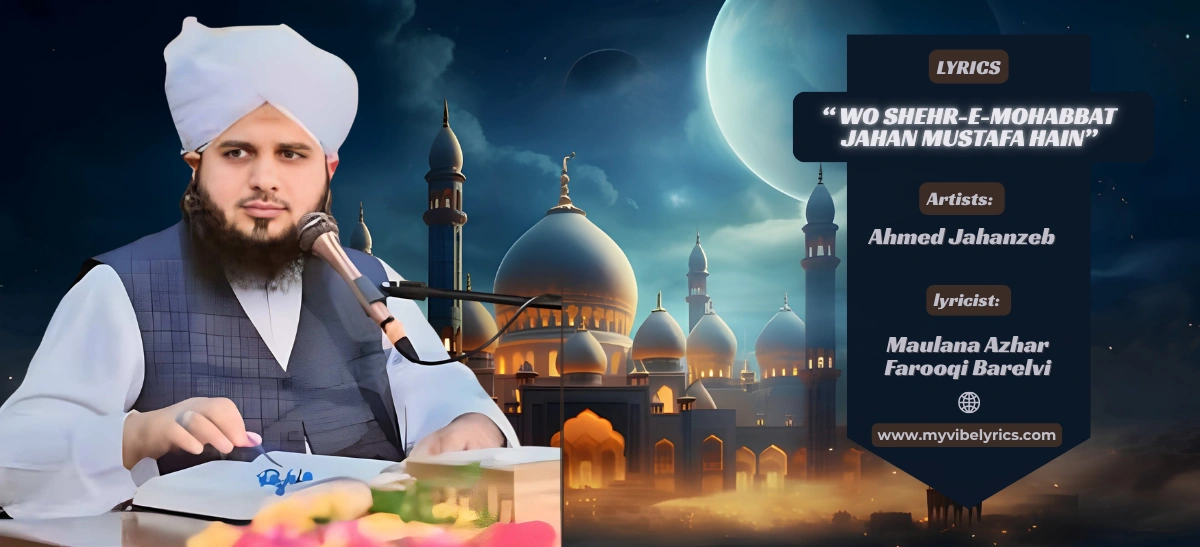
There are Naats you listen to once and forget. And then there are Naats like Wo Shahre Mohabbat Jahan Mustafa Hai the kind that settle into your chest and never quite leave. If you have ever searched for these lyrics, you already know what this Naat does to a person. It doesn’t just describe love for the Prophet ﷺ. It is that love, compressed into Urdu verse so precise and so tender that even those who don’t understand every word can feel it in their bones.
From its soulful verses to its lasting spiritual impact, this timeless Naat continues to resonate with listeners of every generation. Discover the poet behind it, the voice that made it unforgettable, the complete Wo Shahre Mohabbat Jahan Mustafa Hai Lyrics in Hindi, the full English transliteration, and the deeper emotions that keep this beloved Kalam alive in people’s hearts even today.
Overview: About the Song and Its Creators
| Detail | Information |
|---|---|
| Naat Title | वो शहर-ए-मोहब्बत जहाँ मुस्तफ़ा हैं / Wo Shehr-e-Mohabbat Jahan Mustafa Hain |
| Poet / Lyricist | Maulana Azhar Farooqi Barelvi |
| Genre | Naat Sharif (Islamic Devotional Poetry) |
| Language | Urdu / Hindi |
| Album / Film | Standalone Naat – no film association |
| Naat-Khwaans (Reciters) | Tahir Raza Rampuri, Zohaib Ashrafi, Mueen Qadri Bangalore, Hafiz Umar Farooq Naqshbandi, Muhammad Anas Nazeer |
| Subject | Love for Prophet Muhammad ﷺ and longing for Madinah |
| Theme | Spiritual devotion, Ishq-e-Rasool (love of the Prophet ﷺ) |
About the Poet – Maulana Azhar Farooqi Barelvi
Maulana Azhar Farooqi Barelvi is a distinguished Urdu poet whose pen has been devoted almost entirely to the praise of Prophet Muhammad ﷺ. His poetry is known for its classical elegance, emotional depth, and the way it weaves real Islamic history into verse referencing companions like Hazrat Abu Bakr Siddiq ؓ, Hazrat Umar ؓ, Bilal al-Habashi ؓ, Hanzala ؓ, and Uwais al-Qarani ؓ, each a living embodiment of the love being described. His name appears at the end of the Naat itself a classical tradition when the verse reads: “Ai Azhar!”
About the Reciters
This Naat has been recited by some of the most respected voices in the world of Naat-Khwani. Tahir Raza Rampuri brings a classical North Indian Urdu pronunciation that makes every syllable feel weighed and deliberate. Zohaib Ashrafi, known for his emotionally expressive style, renders verses about longing for Madinah with a vulnerability that resonates deeply. Mueen Qadri Bangalore, Hafiz Umar Farooq Naqshbandi, and Muhammad Anas Nazeer each bring their own regional inflections, which is why the same Naat sounds distinct and equally moving across versions.
Wo Shahre Mohabbat Jahan Mustafa Hai Lyrics in Hindi
वो शहर-ए-मोहब्बत जहाँ मुस्तफ़ा हैं
वहीं घर बनाने को जी चाहता है
वो सोने से कंकर, वो चाँदी सी मिट्टी
नज़र में बसाने को जी चाहता है
वो शहर-ए-मोहब्बत जहाँ मुस्तफ़ा हैं
वहीं घर बनाने को जी चाहता है
क़दम जिस ज़मीं पर रखे हैं नबी ने
वहाँ खोल रक्खे हैं दर रौशनी ने
वो गलियाँ जहाँ चलते थे मेरे आक़ा
वहाँ दिल बिछाने को जी चाहता है
वो शहर-ए-मोहब्बत जहाँ मुस्तफ़ा हैं
वहीं घर बनाने को जी चाहता है
जो पूछा नबी ने कि कुछ घर भी छोड़ा
तो सिद्दीक़-ए-अकबर के होंटों पे आया
वहाँ माल-ओ-दौलत की क्या है हक़ीक़त
जहाँ दिल लुटाने को जी चाहता है
वो शहर-ए-मोहब्बत जहाँ मुस्तफ़ा हैं
वहीं घर बनाने को जी चाहता है
जो देखा है रू-ए-जमाल-ए-रिसालत
तो बोले ‘उमर, मुस्तफ़ा जान-ए-रहमत !
बड़ी आप से दुश्मनी थी मगर अब
ग़ुलामी में आने को जी चाहता है
वो शहर-ए-मोहब्बत जहाँ मुस्तफ़ा हैं
वहीं घर बनाने को जी चाहता है
जिहाद-ए-मोहब्बत की आवाज़ गूँजी
कहा हन्ज़ला ने ये दुल्हन से अपनी
इजाज़त अगर दो तो जाम-ए-शहादत
लबों से लगाने को जी चाहता है
वो शहर-ए-मोहब्बत जहाँ मुस्तफ़ा हैं
वहीं घर बनाने को जी चाहता है
उधर दीद-ए-आक़ा में हर-दम तड़पते
इधर हर घड़ी माँ की ख़िदमत में रहते
उवैस अपनी हालत बताते भी किस को
मदीने में जाने को जी चाहता है
वो शहर-ए-मोहब्बत जहाँ मुस्तफ़ा हैं
वहीं घर बनाने को जी चाहता है
सितम का सबब कोई पूछे तो जा कर
कहेंगे बिलाल-ए-हबस मुस्कुरा कर
तड़पते सिसकते हुए उन की ख़ातिर
मेरा जाँ से जाने को जी चाहता है
वो शहर-ए-मोहब्बत जहाँ मुस्तफ़ा हैं
वहीं घर बनाने को जी चाहता है
सितारों से ये चाँद कहता है हर-दम
तुम्हें क्या बताऊँ दो टुकड़ों का ‘आलम
इशारे में आक़ा के इतना मज़ा था
कि फिर टूट जाने को जी चाहता है
वो शहर-ए-मोहब्बत जहाँ मुस्तफ़ा हैं
वहीं घर बनाने को जी चाहता है
वो नन्हा सा असग़र, वो एड़ी रगड़ कर
यही कह रहा है वो ख़ैमे में रो कर
ऐ बाबा ! मैं पानी का प्यासा नहीं हूँ
मेरा सर कटाने को जी चाहता है
वो शहर-ए-मोहब्बत जहाँ मुस्तफ़ा हैं
वहीं घर बनाने को जी चाहता है
जो बच्चे गए बद्र में सब से छुप कर
जिन्हों ने उड़ाया अबू-जहल का सर
ख़ुदा की क़सम उन को दूल्हा बना कर
गले से लगाने को जी चाहता है
वो शहर-ए-मोहब्बत जहाँ मुस्तफ़ा हैं
वहीं घर बनाने को जी चाहता है
वो आक़ा की मस्जिद, वो आक़ा का गुंबद
वो आक़ा की जाली, वो आक़ा का रौज़ा
तसव्वुर में तस्वीर उन की बना कर
वहीं डूब जाने को जी चाहता है
वो शहर-ए-मोहब्बत जहाँ मुस्तफ़ा हैं
वहीं घर बनाने को जी चाहता है
‘अजब कैफ़ियत आने लगती है दिल पर
‘अजब बेख़ुदी छाने लगती है दिल पर
मदीने की जब छेड़ दे कोई बातें
तो ना’तें सुनाने को जी चाहता है
वो शहर-ए-मोहब्बत जहाँ मुस्तफ़ा हैं
वहीं घर बनाने को जी चाहता है
दीवाना ये मुश्क-ओ-हिना का नहीं है
कोई ‘इत्र भी दिल को भाता नहीं है
महकने की ख़ातिर नबी का पसीना
बदन पे लगाने को जी चाहता है
वो शहर-ए-मोहब्बत जहाँ मुस्तफ़ा हैं
वहीं घर बनाने को जी चाहता है
तुझे देख कर मुस्कुराएगी जन्नत
तेरे गर तलक चल के आएगी जन्नत
कभी देख तो माँ से कह कर, मेरी माँ !
तेरा सर दबाने को जी चाहता है
वो शहर-ए-मोहब्बत जहाँ मुस्तफ़ा हैं
वहीं घर बनाने को जी चाहता है
जो देखा है आक़ा के क़दमों का पत्थर
तो क्या हाल दिल का बताऊँ, ऐ अज़हर !
कभी सर पे रखने को दिल चाहता है
कभी सर झुकाने को जी चाहता है
वो शहर-ए-मोहब्बत जहाँ मुस्तफ़ा हैं
वहीं घर बनाने को जी चाहता है
Wo Shahre Mohabbat Jahan Mustafa Hai Lyrics in English
wo shehr-e-mohabbat jahaan mustafa hain
wahiin ghar banaane ko jee chaahta hai
wo sone se kankar, wo chaandi si miTTi
nazar mein basaane ko jee chaahta hai
wo shehr-e-mohabbat jahaan mustafa hain
wahiin ghar banaane ko jee chaahta hai
qadam jis zamiin par rakhe hain nabi ne
wahaan khol rakkhe hain dar raushani ne
wo galiyaan jahaan chalte the mere aaqa
wahaan dil bichhaane ko jee chaahta hai
wo shehr-e-mohabbat jahaan mustafa hain
wahiin ghar banaane ko jee chaahta hai
jo poochha nabi ne ki kuchh ghar bhi chhoRa
to siddiq-e-akbar ke honTon pe aaya
wahaan maal-o-daulat ki kya hai haqeeqat
jahaan dil luTaane ko jee chaahta hai
wo shehr-e-mohabbat jahaan mustafa hain
wahiin ghar banaane ko jee chaahta hai
jo dekha hai roo-e-jamaal-e-risaalat
to bole ‘umar, mustafa jaan-e-rahmat!
baRi aap se dushmani thi magar ab
gulaami mein aane ko jee chaahta hai
wo shehr-e-mohabbat jahaan mustafa hain
wahiin ghar banaane ko jee chaahta hai
jihaad-e-mohabbat ki aawaz goonji
kaha hanzala ne ye dulhan se apni
ijaazat agar do to jaam-e-shahaadat
labon se lagaane ko jee chaahta hai
wo shehr-e-mohabbat jahaan mustafa hain
wahiin ghar banaane ko jee chaahta hai
udhar deed-e-aaqa mein har-dam taRapte
idhar har ghaRi maan ki khidmat mein rehte
uwais apni haalat bataate bhi kis ko
madine mein jaane ko jee chaahta hai
wo shehr-e-mohabbat jahaan mustafa hain
wahiin ghar banaane ko jee chaahta hai
sitam ka sabab koi poochhe to ja kar
kahenge bilaal-e-habas muskura kar
taRapte sisakte hue un ki khaatir
mera jaan se jaane ko jee chaahta hai
wo shehr-e-mohabbat jahaan mustafa hain
wahiin ghar banaane ko jee chaahta hai
sitaaron se ye chaand kehta hai har-dam
tumhein kya bataoon do TukRon ka ‘aalam
ishaare mein aaqa ke itna maza tha
ki phir TooT jaane ko jee chaahta hai
wo shehr-e-mohabbat jahaan mustafa hain
wahiin ghar banaane ko jee chaahta hai
wo nanha sa asGar, wo eRi ragaR kar
yahi keh raha hai wo khaime mein ro kar
ai baaba! main paani ka pyaasa nahin hoon
mera sar kaTaane ko jee chaahta hai
wo shehr-e-mohabbat jahaan mustafa hain
wahiin ghar banaane ko jee chaahta hai
jo bachche gae badr mein sab se chhup kar
jinhon ne uRaaya abu-jahal ka sar
Khuda ki qasam un ko dulha bana kar
gale se lagaane ko jee chaahta hai
wo shehr-e-mohabbat jahaan mustafa hain
wahiin ghar banaane ko jee chaahta hai
wo aaqa ki masjid, wo aaqa ka gumbad
wo aaqa ki jaali, wo aaqa ka rauza
tasawwur mein tasweer un ki bana kar
wahiin Doob jaane ko jee chaahta hai
wo shehr-e-mohabbat jahaan mustafa hain
wahiin ghar banaane ko jee chaahta hai
‘ajab kaifiyat aane lagti hai dil par
‘ajab bekhuudi chhaane lagti hai dil par
madine ki jab cheR de koi baatein
to naa’tein sunaane ko jee chaahta hai
wo shehr-e-mohabbat jahaan mustafa hain
wahiin ghar banaane ko jee chaahta hai
deewana ye mushk-o-hina ka nahin hai
koi ‘itr bhi dil ko bhaata nahin hai
mahakne ki khaatir nabi ka paseena
badan pe lagaane ko jee chaahta hai
wo shehr-e-mohabbat jahaan mustafa hain
wahiin ghar banaane ko jee chaahta hai
tujhe dekh kar muskuraaegi jannat
tere gar talak chal ke aaegi jannat
kabhi dekh to maan se keh kar, meri maan!
tera sar dabaane ko jee chaahta hai
wo shehr-e-mohabbat jahaan mustafa hain
wahiin ghar banaane ko jee chaahta hai
jo dekha hai aaqa ke qadmon ka patthar
to kya haal dil ka bataoon, ai Azhar!
kabhi sar pe rakhne ko dil chaahta hai
kabhi sar jhukaane ko jee chaahta hai
wo shehr-e-mohabbat jahaan mustafa hain
wahiin ghar banaane ko jee chaahta hai
English Translation (Verse-by-Verse Meaning)
Understanding the Wo Shahre Mohabbat Jahan Mustafa Hai lyrics in English translation deepens the experience considerably. Here is what each major verse conveys:
Mukhda (Refrain): “That city of love where Mustafa ﷺ resides my heart yearns to make a home right there. Those pebbles of gold, that soil like silver my eyes long to hold that vision forever.”
This opening sets the entire emotional register of the Naat. Madinah is not described through geography but through devotion its very soil elevated to gold and silver by the blessed presence of the Prophet ﷺ.
Verse 1 – The Sacred Streets: “The earth where the Prophet ﷺ placed his blessed feet light itself has opened its doors there. Those lanes where my Master once walked my heart longs to lay itself down in those very streets.”
Verse 2 – Hazrat Abu Bakr Siddiq ؓ: “When the Prophet ﷺ asked if anything had been left at home, Siddiq-e-Akbar replied from his lips what is the meaning of wealth and riches, in a place where the heart yearns to give everything away?”
This verse references the famous incident of Hijrat (migration) a moment that encapsulates the ultimate sacrifice of the closest companion.
Verse 3 – Hazrat Umar ؓ: “On seeing the blessed face of Prophethood, Umar said: O Mustafa, soul of mercy! I once held great enmity toward you, but now my heart longs to enter into your servitude.”
One of the most powerful stanzas capturing the dramatic transformation of Hazrat Umar ؓ from fierce opponent to devoted servant.
Verse 4 – Hazrat Hanzala ؓ: “The call of the Jihad of love echoed Hanzala said to his bride: if you give permission, the cup of martyrdom is what my lips long to taste.”
Hazrat Hanzala ؓ left his wedding night for the battlefield of Uhud. This verse immortalises that sacrifice without melodrama just quiet, devastating devotion.
Verse 5 – Hazrat Uwais al-Qarani ؓ: “On that side, always yearning for a glimpse of the Master ﷺ; on this side, serving his mother every moment Uwais, to whom could he even describe his state? His heart longs to go to Madinah.”
Uwais al-Qarani ؓ never met the Prophet ﷺ in person yet is counted among the greatest of Tabi’een. This verse captures a longing so pure it transcends physical presence.
Verse 6 – Hazrat Bilal ؓ: “If someone asks the reason for the cruelty he endured Bilal al-Habash will smile and say: writhing and sobbing for his sake, my soul longs to depart.”
The torture of Bilal ؓ described not through outrage but through his own smiling acceptance one of the most emotionally resonant images in the Naat.
Verse 7 – The Moon and the Miracle of Shaqq-ul-Qamar: “The moon constantly tells the stars how do I describe to you the state of being split in two? There was such joy in the Master’s ﷺ single gesture that I long to be split apart again.”
A reference to the miracle of Shaqq-ul-Qamar (splitting of the moon) narrated not as a historical event but as the moon’s own wish to relive that blessed moment.
Verse 8 – Hazrat Ali Asghar ؓ (Karbala): “That little Asghar, scraping his heels, crying in the tent, saying: O father! I am not thirsty for water my head longs to be offered.”
This verse shifts the Naat’s emotional weight entirely. The infant Ali Asghar ؓ at Karbala six months old, killed by an arrow is depicted not as a victim but as a willing participant in the love of the Prophet’s ﷺ lineage. It is one of the most heart-rending verses in Urdu devotional poetry.
Verse 9 – The Young Companions at Badr: “Those young boys who went to Badr secretly, those who struck down Abu Jahl by Allah, my heart longs to embrace them as grooms.”
Verse 10 – The Sacred Mosque and Tomb: “That mosque of the Master ﷺ, that blessed green dome, that sacred lattice, that noble resting place creating a picture of them in my imagination, my heart longs to sink into it forever.”
This is the verse most associated with the visual imagery of Madinah’s Masjid-un-Nabawi.
Verse 11 – The State of the Heart: “A strange rapture begins to descend upon the heart a strange ecstasy starts to overwhelm the soul whenever someone begins to speak of Madinah, the heart longs to recite Naats.”
Verse 12 – Fragrance of the Prophet ﷺ: “This heart is not captivated by musk or henna no perfume pleases this soul at all for the sake of fragrance, my heart longs to apply the blessed perspiration of the Prophet ﷺ upon my body.”
This verse, while startling to modern sensibilities, is rooted in classical Islamic tradition the companions preserved and treasured the blessed fragrance of the Prophet ﷺ.
Verse 13 – Paradise and a Mother’s Service: “Paradise will smile upon seeing you Paradise will walk to your very threshold go and tell your mother, my dear: my heart longs to press her head.”
A tender verse that grounds the spiritual in the deeply personal even at the peak of devotion, a mother’s service is remembered.
Final Verse – The Poet’s Signature: “When I saw the stone blessed by the Master’s ﷺ feet how do I describe the state of my heart, O Azhar! Sometimes the heart longs to place it on my head sometimes it longs to bow before it.”
The poet signs off with his own name a classical convention and does so not with pride but with helplessness. It is a fitting close.
Disclaimer
The lyrics of Wo Shehr-e-Mohabbat Jahan Mustafa Hain belong to the original poet, Maulana Azhar Farooqi Barelvi, and the recitation rights belong to the respective Naat-Khwaans Tahir Raza Rampuri, Zohaib Ashrafi, Mueen Qadri Bangalore, Hafiz Umar Farooq Naqshbandi, and Muhammad Anas Nazeer. These lyrics are presented solely for appreciation, spiritual benefit, and educational purposes. Please support the original artists by streaming or listening to their recordings on licensed platforms.
Musical Composition and Vocal Performance
What makes this Naat compositionally distinct is its restraint. The mukhda (refrain) Wo Shahre Mohabbat Jahan Mustafa Hai is structured with a falling cadence that creates an almost aching sense of longing. The internal rhyme scheme across verses is rigorous without being mechanical, and Maulana Azhar Farooqi Barelvi sustains a unified emotional thread across twelve-plus stanzas a feat that few Naat poets achieve.
Tahir Raza Rampuri’s rendition is considered among the most classical. His pacing is deliberate he gives every compound word its full weight. When he reaches verses like the Hanzala stanza or the Ali Asghar verse, he slows further, allowing the imagery to land.
Zohaib Ashrafi’s version is more melodically expressive, with subtle tonal shifts that underline the contrast between verses of historical heroism and verses of personal longing.
Mueen Qadri Bangalore brings a South Indian Urdu pronunciation that softens certain consonants, giving the Naat a different warmth particularly in the verses about Uwais al-Qarani ؓ and the moon.
What unifies all versions is the refrain. No matter who recites it, the line “wahiin ghar banaane ko jee chaahta hai” “my heart longs to make a home right there” carries the same weight. It is a line that compresses an entire lifetime of devotion into seven words.
? Frequently Asked Questions (FAQ)
Q1. Who wrote Wo Shahre Mohabbat Jahan Mustafa Hai?
It was written by Maulana Azhar Farooqi Barelvi, a renowned Urdu Naat poet. His name appears in the final verse of the Naat itself a classical tradition of embedding the poet’s name (takhallus) in the closing stanza.
Q2. Who are the singers / Naat-Khwaans of this Naat?
Multiple reciters have recited this Naat, including Tahir Raza Rampuri, Zohaib Ashrafi, Mueen Qadri Bangalore, Hafiz Umar Farooq Naqshbandi, and Muhammad Anas Nazeer.
Q3. Which film or album does this Naat belong to?
This is a standalone Naat Sharif and is not associated with any film or commercial album. It belongs to the tradition of classical Urdu devotional poetry.
Q4. What is the meaning of “Wo Shahre Mohabbat Jahan Mustafa Hai”?
It translates roughly as: “That city of love where Mustafa ﷺ resides.” The full refrain means: the heart longs to make a home in Madinah the city blessed by the presence of Prophet Muhammad ﷺ.
Q5. What historical figures are mentioned in this Naat?
The Naat references Hazrat Abu Bakr Siddiq ؓ, Hazrat Umar ؓ, Hazrat Hanzala ؓ, Hazrat Uwais al-Qarani ؓ, Hazrat Bilal al-Habashi ؓ, Hazrat Ali Asghar ؓ, and the young companions present at the Battle of Badr.
Q6. Is this Naat available with English translation?
A full verse-by-verse English translation and transliteration of Wo Shahre Mohabbat Jahan Mustafa Hai Lyrics in English is provided in this article above.
Q7. What is the genre of this composition?
It is a Naat Sharif a form of Islamic devotional poetry specifically composed in praise of and longing for Prophet Muhammad ﷺ. It belongs to the classical Urdu-Barelvi tradition of Naat-Khwani.

 If You Liked The Lyrics Of This Songs, Check Out Also These Lyrics As Well:
- Biba Sada Dil Mod De Lyrics
- Tenu Sang Rakhna Lyrics
- Hariharan Aarti Kunj Bihari Ki Lyrics
- Main Rahoon Ya Na Rahoon Lyrics
- Kaise Bataye Kyun Tujhko Chahe Lyrics
- Shreya Ghoshal Chikni Chameli Lyrics
- Main Rang Sharbaton Ka Lyrics
- Tere Hawale Kar Diya Lyrics
- Aankhein Khuli Ho Ya Ho Band Lyrics
- Unke Andaz e Karam Lyrics
- shqa Ve Chadeya Lyrics
- Predador De Perereca Lyrics English
- Tenu Takiya Bina Ni Dil Rajda Lyrics
- Lakhbir Singh Lakha Keejo Kesari Ke Laal Lyrics
- Krsna Hola Amigo Lyrics
- Ek Khatola Jail Ke Bhitar Lyrics
- Guzarishein Samar Jafri Lyrics
- Dar E Zindan Par Koi Masooma Lyrics
- Cherrapunji Song Lyrics
- Surmedani Lyrics in Hindi
- Sohail Sen Aashiq Tera Lyrics
- Hum Toh Chupke Tumko Dekha Karte Hai Lyrics
- Bewafa Tera Masoom Chehra Lyrics
- Fa9la Lyrics (Dhurandhar)
- Jaane Tamanna Jaane Ada Lyrics