

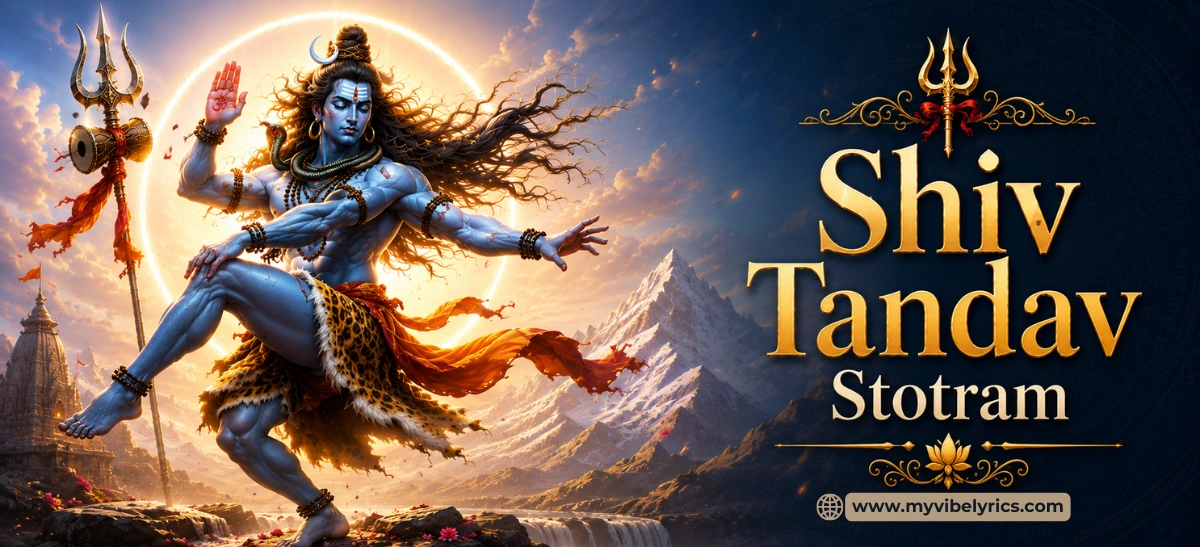
When people search for Shiv Tandav Stotram lyrics in English, they want more than words, they want to feel what Ravana felt at the feet of Mahadev.
Ravana once tried to lift Mount Kailash out of arrogance. Shiva pinned him with a single toe. Trapped and humbled, Ravana composed this stotram on the spot, each verse torn from him in pain. Shiva was so moved that he freed Ravana and gifted him the celestial sword Chandrahas.
This hymn was not written in comfort. It was written in agony and surrender, and every verse still carries that raw energy.
The Shiv Tandav Stotram has 16 quatrains, each line built on 16 syllables in a precise short-long (Laghu-Guru) pattern. Chanted aloud, it sounds like a drum. That is intentional, it mimics Shiva’s Damaru and the rhythm of the Tandav itself.
Overview: About The Shiv Tandav Stotram
| Detail | Information |
|---|---|
| Song / Stotram Title | Shiv Tandav Stotram (शिव तांडव स्तोत्रम्) |
| Original Composer / Lyricist | Ravana (Dashanan), King of Lanka |
| Popular Singer | Shankar Mahadevan |
| Music Composer (2016 Version) | Shailesh Dani |
| Album (2016 Version) | Shiv Tandav Stotram, Single |
| Label | Times Music Spiritual |
| Release Year | 2016 (Shankar Mahadevan version) |
| Language | Sanskrit |
| Genre | Devotional / Spiritual Stotra |
| Duration | 9:13 minutes (Shankar Mahadevan version) |
| Total Verses | 16 (including Phalashruti) |
Shankar Mahadevan’s Version: Why It Became the Definitive Rendition
Many artists have recorded the Shiv Tandav Stotram, but the 2016 version by Shankar Mahadevan, composed by Shailesh Dani, released under Times Music Spiritual, became the definitive modern rendition.
Trained in Carnatic classical music and known for iron breath control (his Breathless album, 1998, is still iconic), Mahadevan delivers 9 minutes 13 seconds of sustained devotional intensity. Every Sanskrit syllable lands precisely, and the Damaru beats feel physical.
In 2025, he released a new trending version under the same label. The stotra keeps resurging, because the words are simply that powerful.
Shiv Tandav Stotram Lyrics in Hindi (Sanskrit, Devanagari Script)
Original composition attributed to Ravana. Traditional Sanskrit text, public domain.
॥ शिवताण्डवस्तोत्रम् ॥
पद्य १
जटाटवीगलज्जलप्रवाहपावितस्थले
गलेऽवलम्ब्य लम्बितां भुजङ्गतुङ्गमालिकाम् ।
डमड्डमड्डमड्डमन्निनादवड्डमर्वयं
चकार चण्डताण्डवं तनोतु नः शिवः शिवम् ॥१॥
पद्य २
जटाकटाहसम्भ्रमभ्रमन्निलिम्पनिर्झरी
विलोलवीचिवल्लरीविराजमानमूर्धनि ।
धगद्धगद्धगज्ज्वलल्ललाटपट्टपावके
किशोरचन्द्रशेखरे रतिः प्रतिक्षणं मम ॥२॥
पद्य ३
धराधरेन्द्रनन्दिनीविलासबन्धुवन्धुर-
स्फुरद्दिगन्तसन्ततिप्रमोदमानमानसे ।
कृपाकटाक्षधोरणीनिरुद्धदुर्धरापदि
क्वचिद्दिगम्बरे मनो विनोदमेतु वस्तुनि ॥३॥
पद्य ४
जटाभुजङ्गपिङ्गलस्फुरत्फणामणिप्रभा-
कदम्बकुङ्कुमद्रवप्रलिप्तदिग्वधूमुखे ।
मदान्धसिन्धुरस्फुरत्त्वगुत्तरीयमेदुरे
मनो विनोदमद्भुतं बिभर्तु भूतभर्तरि ॥४॥
पद्य ५
सहस्रलोचनप्रभृत्यशेषलेखशेखर-
प्रसूनधूलिधोरणी विधूसराङ्घ्रिपीठभूः ।
भुजङ्गराजमालया निबद्धजाटजूटकः
श्रियै चिराय जायतां चकोरबन्धुशेखरः ॥५॥
पद्य ६
ललाटचत्वरज्वलद्धनञ्जयस्फुलिङ्गभा-
निपीतपञ्चसायकं निमन्निलिम्पनायकम् ।
सुधामयूखलेखया विराजमानशेखरं
महाकपालिसम्पदे शिरोजटालमस्तु नः ॥६॥
पद्य ७
कराल भालपट्टिकाधगद्धगद्धगज्ज्वल-
द्धनञ्जयाहुतीकृतप्रचण्डपञ्चसायके ।
धराधरेन्द्रनन्दिनीकुचाग्रचित्रपत्रक-
प्रकल्पनैकशिल्पिनि त्रिलोचने रतिर्मम ॥७॥
पद्य ८
नवीनमेघमण्डली निरुद्धदुर्धरस्फुर-
त्कुहूनिशीथिनीतमः प्रबन्धबन्धुकन्धरः ।
निलिम्पनिर्झरीधरस्तनोतु कृत्तिसिन्धुरः
कलानिधानबन्धुरः श्रियं जगद्धुरन्धरः ॥८॥
पद्य ९
प्रफुल्लनीलपङ्कजप्रपञ्चकालिमच्छटा-
विडम्बि कण्ठकन्दलीरुचिप्रबन्धकन्धरम् ।
स्मरच्छिदं पुरच्छिदं भवच्छिदं मखच्छिदं
गजच्छिदान्धकच्छिदं तमन्तकच्छिदं भजे ॥९॥
पद्य १०
अखर्वसर्वमङ्गलाकलाकदम्बमञ्जरी
रसप्रवाहमाधुरीविजृम्भणामधुव्रतम् ।
स्मरान्तकं पुरान्तकं भवान्तकं मखान्तकं
गजान्तकान्धकान्तकं तमन्तकान्तकं भजे ॥१०॥
पद्य ११
जयत्वदभ्रविभ्रमभ्रमद्भुजङ्गमस्फुर-
द्धगद्धगद्विनिर्गमत्कराल भालहव्यवाट् ।
धिमिद्धिमिद्धिमिध्वनन्मृदङ्गतुङ्गमङ्गल
ध्वनिक्रमप्रवर्तित प्रचण्डताण्डवः शिवः ॥११॥
पद्य १२
दृषद्विचित्रतल्पयोर्भुजङ्गमौक्तिकस्रजो-
र्गरिष्ठरत्नलोष्ठयोः सुहृद्विपक्षपक्षयोः ।
तृणारविन्दचक्षुषोः प्रजामहीमहेन्द्रयोः
समं प्रवर्तयन्मनः कदा सदाशिवं भजे ॥१२॥
पद्य १३
कदा निलिम्पनिर्झरीनिकुञ्जकोटरे वसन्
विमुक्तदुर्मतिः सदा शिरःस्थमञ्जलिं वहन् ।
विमुक्तलोललोचनो ललामभाललग्नकः
शिवेति मन्त्रमुच्चरन् कदा सुखी भवाम्यहम् ॥१३॥
पद्य १४
निलिम्पनाथनागरी कदम्बमौलमल्लिका-
निगुम्फनिर्भरक्षरन्मधूष्णिकामनोहरम् ।
तनोतु नो मनोमुदं विनोदिनीमहर्निशम्
परिश्रयं परं पदं तदङ्गजत्विषां चयः ॥१४॥
पद्य १५
प्रचण्डवाडवानलप्रभाशुभप्रचारणी
महाष्टसिद्धिकामिनी जनावहूतजल्पना ।
विमुक्तवामलोचनो विवाहकालिकध्वनिः
शिवेति मन्त्रभूषणो जगज्जयाय जायताम् ॥१५॥
पद्य १६ (फलश्रुति)
इमं हि नित्यमेव मुक्तमुत्तमोत्तमं स्तवं
पठन्स्मरन्ब्रुवन्नरो विशुद्धिमेति सन्ततम् ।
हरे गुरौ सुभक्तिमाशु याति नान्यथा गतिम्
विमोहनं हि देहिनां सुशङ्करस्य चिन्तनम् ॥१६॥
फलश्रुति अन्तिम श्लोक
यः शम्भुपूजनपरं पठति प्रदोषे ।
तस्य स्थिरां रथगजेन्द्रतुरङ्गयुक्तां
लक्ष्मीं सदैव सुमुखिं प्रददाति शम्भुः ॥
॥ इति शिव तांडव स्तोत्रं संपूर्णम् ॥
॥ इति शिव तांडव स्तोत्रं संपूर्णम् ॥
Disclaimer
The Shiv Tandav Stotram is an ancient Sanskrit hymn believed to be composed by Ravana, over 2,000 years old. It is part of the Hindu scriptural and devotional tradition and does not belong to any individual, label, or publisher. The text presented here is traditional sacred literature shared purely for devotional, educational, and cultural appreciation.
The musical rendition by Shankar Mahadevan (Times Music Spiritual, 2016) is a separately copyrighted sound recording. Please support the artist by streaming on JioSaavn, Spotify, or YouTube.
Shiv Tandav Stotram Lyrics in English, Transliteration & Translation
Verse 1
Transliteration:
Jatatavigalajjala pravahapavitasthale Gale’valambya lambitam bhujangatungamalikam |
Damaddamaddamaddama ninadavaddamarvayam Chakara chandatandavam tanotu nah shivah shivam ||1||
Meaning: Lord Shiva, from whose forest-like matted hair the Ganga flows and purifies the cobras coiled as garlands around his neck, who danced the fierce Tandav to the thundering ‘Damad Damad’ of the Damaru drum, may that blissful Shiva grant us auspiciousness.
Verse 2
Transliteration:
Jatakataha sambhrama bhramanna nilimpa nirjhari Vilola vichi vallari viraja mana murdhani |
Dhagaddhagaddhagajjvalallalata patta pavake Kishora chandra shekhare ratih pratikshanam mama ||2||
Meaning: Lord Shiva, whose swirling matted locks hold the turbulently flowing Ganga like waving creepers, whose forehead blazes with the fire of his third eye, and who wears a young crescent moon as his crown, in the sight of such Shiva, I find joy at every moment.
Verse 3
Transliteration:
Dharadharendra nandini vilasa bandhu vandhura Sphuradriganta santati pramoda mana manase |
Kripa kataksha dhorani niruddha durdha rapadi Kvachidvigambare mano vinodametu vastuni ||3||
Meaning: Lord Shiva, who joyfully plays with Parvati, daughter of the Mountain King, whose compassionate glance alone removes the gravest sorrows, and who wears the Directions as his garment, may my mind find delight in such a sky-clad Lord.
Verse 4
Transliteration:
Jata bhujanga pingala sphuratphana mani prabha Kadamba kunkuma drava pralipta digva dhumukhe |
Madandha sindhura sphuratvaguttari yamedure Mano vinoda dbhutam bimbhartu bhuta bhartari ||4||
Meaning: Lord Shiva, the sustainer of all existence, whose cobra-garland casts gem-light across the faces of devotees in all directions, who is draped in the skin of a rage-intoxicated elephant, may the wondrous sight of such a Lord fill my heart with joy.
Verse 5
Transliteration:
Sahasra lochana prabhritya shesha lekha shekhara Prasuna dhuli dhorani vidhu sarananghri pithabhuh |
Bhujanga raja malaya nibaddha jata jutakah Shriye chiraya jayatam chakora bandhu shekharah ||5||
Meaning: Lord Shiva, whose feet are dusted with pollen fallen from the bowed heads of Indra, Vishnu, and all the gods, whose locks are bound with the serpent-king, and who wears the moon on his crown, may such Shiva bestow lasting prosperity upon us.
Verse 6
Transliteration:
Lalata chatvara jvaladdhananjaya sphulingabha Nipita panchasayakam nimanna nilimpa nayakam |
Sudha mayukha lekhaya virajamanashekharam Maha kapali sampade shiro jatalamas tu nah ||6||
Meaning: Lord Shiva, whose blazing third-eye fire consumed Kamadeva’s five arrows and humbled the lord of the gods, who gleams with the nectar-rayed crescent moon upon his head, may the matted locks of such a Lord be our ultimate refuge and blessing.
Verse 7
Transliteration:
Karala bhala pattika dhagaddhagaddhagajjvala Ddhananjaya huti kritaprachanda panchasayake |
Dharadharendra nandini kucha grachitrapatra Prakalpanaikashilpini trilochane ratirmama ||7||
Meaning: Lord Shiva, the three-eyed one, whose terrible forehead-fire consumed Kamadeva’s arrows completely, and who artfully adorns the bosom of Parvati, it is in such a three-eyed Lord that I place my deepest devotion.
Verse 8
Transliteration:
Navina megha mandali niruddha durdharasphura Tkuhu nishithinitamah prabandha bandhu kandharah |
Nilimpa nirjhari dhar stanotu kritti sindhurah Kalanidhanabandhurah shriyam jagandhurandharah ||8||
Meaning: Lord Shiva, whose neck is dark as monsoon clouds, who bears the Ganga upon his head, wears elephant skin, and carries the weight of the entire universe, may that great Lord expand and sustain all my prosperity.
Verse 9
Transliteration:
Praphulla nila pankaja prapancha kalimachchhata Vidambi kantha kandali ruchi prabandha kandharam |
Smarachchhidam purachchhidam bhavachchhidam makhachchhidam Gajachchhidandhakachchhidam tamantakachchhidam bhaje ||9||
Meaning: I bow to Lord Shiva, whose throat outshines even the blackness of a bloomed blue lotus, who destroyed Kamadeva, burned the three demon cities, severed worldly bondage, demolished Daksha’s sacrifice, slew Gajasura and Andhakasura, and crushed Yama himself.
Verse 10
Transliteration:
Agarva sarvamangala kalakadamba manjari Rasapravaha madhuri vijrimbhana madhuvratam |
Smarantakam purantakam bhavantakam makhantakam Gajantakandhakantakam tamantakantakam bhaje ||10||
Meaning: I worship Lord Shiva, surrounded by the fragrance of all auspicious arts and divine energies, who destroyed Kama, the three demon cities, worldly bondage, Daksha’s havan, Gajasura, Andhakasura, and Yama, the god of death himself.
Verse 11
Transliteration:
Jayatvadabhravibhrama bhramadbhujangamasphura Ddhagaddhagadvi nirgamatkarala bhala havyavat |
Dhimiddhimiddhimi nanna mridanga tungamangala Dhvanikrama pravartita prachanda tandavah shivah ||11||
Meaning: Victory to Lord Shiva, who performs his fierce Tandav in rhythm with the soaring ‘Dhimid Dhimid’ beats of the Mridanga drum, whose forehead-fire blazes terrifyingly, and whose serpent ornament crackles with flame. That glorious Shiva reigns supreme.
Verse 12
Transliteration:
Drushad vichitra talpayor bhujanga mauktika srajor Garishtharatna loshtayoh suhrid vipaksha pakshayoh |
Trinara vinda chakshushoh praja mahi mahendrayoh Samam pravartayan manah kada sadashivam bhaje ||12||
Meaning: When will I see a stone bed and a soft bed as the same, a snake and a pearl garland as the same, a gem and a lump of earth as the same, friend and foe as the same, a blade of grass and a lotus as the same, and with that perfectly equal mind, truly worship the eternal Sadashiva?
Verse 13
Transliteration:
Kada nilimpa nirjhari nikujakotare vasan Vimuktadurmatih sada shirahsthamanjalim vahan |
Vimuktalola lochano lalama bhala lagnakah Shiveti mantramuccharan kada sukhi bhavamyaham ||13||
Meaning: When will I live in the cave on the banks of the divine Ganga, free from impure thoughts, hands raised above my head in salutation, eyes freed from desire, absorbed in Shiva’s sacred forehead-mark, chanting “Shiva” and truly know happiness?
Verse 14
Transliteration:
Nilimpa natha nagari kadamba maula mallika Nigumpha nirbhaksharanma dhushnika manoharah |
Tanotu no manomudam vinodinima hanisham Parishraya param padam tadanga jatvisham chayah ||14||
Meaning: May the divine radiance from every part of Lord Shiva’s form, as fragrant and beautiful as jasmine clusters woven through Kadamba flowers, fill our minds with joy and grant us the supreme refuge, day and night without end.
Verse 15
Transliteration:
Prachanda vadavanala prabha shubha pracharani Mahashtasiddhi kamini janavahuta jalpana |
Vimukta vama lochano vivahaka lika dhvanih Shiveti mantra bhushano jagajjayaya jayatam ||15||
Meaning: May the sacred resonance of the “Shiva” mantra, that divine energy which burns away all sin, grants the eight great siddhis, and echoed during the auspicious wedding of Shiva and Parvati, prevail across all worlds and relieve all living beings of suffering.
Verse 16, Phalashruti
Transliteration:
Imam hi nityameva muktamuttamottamam stavam Pathansmaran bruvannaro vishuddhameti santatam |
Hare gurau subhaktimashu yati nanyatha gatim Vimohanam hi dehinam sushankarasya chintanam ||16||
Meaning: Whoever reads, remembers, and recites this supreme eternal hymn shall be continuously purified. They shall quickly attain pure devotion to the Lord and the Guru. There is no other path, the very contemplation of benevolent Shankara removes all delusions from the soul.
Phalashruti, Final Benediction Verse
Transliteration:
Puja’vasana samaye dasha vaktra gitam Yah shambhu pujanam idam pathati pradoshe |
Tasya sthiram ratha gajendra turanga yuktam Lakshmi sadaiva sumukhim pradadati shambhuh ||
Meaning: Whoever recites this hymn, sung by the ten-headed Ravana, during the evening Pradosha, at the close of Lord Shambhu’s worship, shall be blessed by Shambhu himself with lasting wealth, chariots, elephants, horses, and all auspiciousness.
॥ Iti Shiv Tandav Stotram Sampoornam ॥ (Thus, the Shiv Tandav Stotram is complete.)
Musical Composition and Vocal Performance
The stotram follows the Panchachamara meter, 16 syllables per line in a rolling short-long pattern. This creates natural forward momentum when chanted, like an accelerating war drum.
Shailesh Dani’s 2016 composition builds from a quiet tabla opening and layers in strings and percussion as verses escalate. By Verse 11, the production sound-mirrors the Dhimid Dhimid described in the lyrics itself, form and content perfectly aligned.
Three things that set Shankar Mahadevan apart:
- Breath control, each verse flows as one unbroken phrase
- Sanskrit diction, every double consonant (Dhagaddhagad, Damaddamad) lands cleanly
- Dynamic range, near-whisper at Verse 12, near-roar at Verse 11, within the same track
Before 2016, the Shiv Tandav Stotram in Sanskrit was mostly a temple chant. After this version hit YouTube and JioSaavn, it became a mainstream spiritual anthem.
Why Shiv Tandav Stotram Lyrics Hit So Hard
Most hymns praise a deity from the outside. The Shiv Tandav Stotram makes you feel the Tandav through sound itself.
The onomatopoeia is intentional and brilliant. Lines like “Damaddamaddamaddama” (Verse 1) and “Dhimiddhimiddhimi” (Verse 11) recreate drum sounds in your mouth when chanted, Ravana composed music with language.
The emotional arc is equally underrated. Verses 1–5 open with awe. Verses 6–11 escalate into surrender and praise. Then Verse 12 pivots sharply inward, when will I see all things equally?, and Verse 13 ends with a quiet longing for a simple life by the Ganga. It is the complete journey of a devotee: arrogant to humbled to transformed.
Verses 9 and 10 list every great destruction Shiva performed, Kama, Tripura, Daksha’s sacrifice, Yama, each one a metaphor for something inside us. These Shiv Tandav Stotram lyrics are not poetry about a God. They are a map of inner transformation.
Spiritual Significance and Benefits of Chanting
The stotram is traditionally chanted during Pradosha (13th lunar tithi at twilight), Maha Shivaratri, Monday mornings, and any period of personal difficulty or spiritual seeking. The Phalashruti verse specifically names Pradosha as the most auspicious time.
Consistent recitation is said to purify the mind, dissolve ego, remove obstacles, and grant the devotee what the final verse calls Sadashiva darshan, the vision of the eternal Shiva.
For beginners: Start slowly. Internalize each verse’s meaning before chanting it at pace. The double consonants (jjala, nninad, ddama) are not typos, they carry the percussive punch the meter requires and must be pronounced as written.
? FAQs: Shiv Tandav Stotram Lyrics
Q1. Who wrote the Shiv Tandav Stotram?
Ravana, the ten-headed king of Lanka, composed it while pinned under Mount Kailash as an act of surrender to Lord Shiva.
Q2. How many verses does it have?
16 verses total, including the Phalashruti (fruit verse) at the end.
Q3. What language is it written in?
Classical Sanskrit, written in Devanagari script.
Q4. Who is the best singer of Shiv Tandav Stotram?
Shankar Mahadevan’s 2016 version (Times Music Spiritual) is the most popular and widely streamed rendition.
Q5. What is the best time to chant it?
During Pradosha (twilight on the 13th lunar day), Maha Shivaratri, or Monday mornings.
Q6. Can anyone chant the Shiv Tandav Stotram?
Yes. No restrictions on caste, gender, or age. Devotion is the only requirement.
Q7. What does “Tandav” mean?
The fierce cosmic dance of Lord Shiva. At least 8 forms exist, including Rudra Tandav (ferocious) and Ananda Tandav (joyful).
Q8. What are the benefits of chanting it?
Purifies the mind, removes negative energy, dissolves ego, and grants divine grace per the Phalashruti.

 If You Liked The Lyrics Of This Songs, Check Out Also These Lyrics As Well:
- Maa Murade Puri Karde Halwa Batungi Lyrics
- Ye Chamak Ye Damak Lyrics
- Mere Hussain Tujhe Salaam Lyrics
- Religious India Namami Shamishan Lyrics
- Ram Ji Ki Nikli Sawari Lyrics
- Hariharan Bajrang Baan Lyrics
- Anuradha Paudwal Siddha Kunjika Stotram Lyrics
- He Bholya Shankara Lyrics in Marathi
- Surya Chalisa Lyrics
- लेडीज कीर्तन भजन लिरिक्स
- Thali Bhar Ke Layi Re Khichdo Lyrics
- Wo Shahre Mohabbat Jahan Mustafa Hai Lyrics
- Chandrachooda Shiva Shankara Lyrics
- Vrindavan Me Hukum Chale Barsane Wali Ka Lyrics
- Kya Bataun Ke Kya Madina Hai Lyrics
- Sab Kuch Sarkar Tumhi Se Hai Lyrics
- Tulsi Vivah Mangalashtak
- Kaal Bhairav Ashtakam Lyrics in Hindi
- Aditya Hridaya Stotra Lyrics