

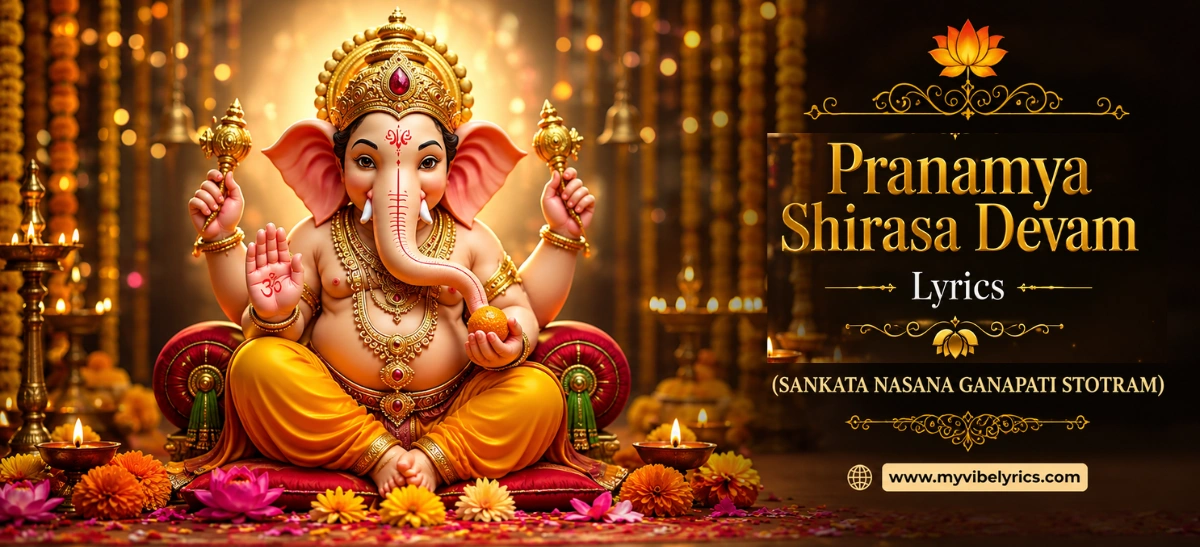
The Pranamya Shirasa Devam Lyrics are not a modern composition. They come from the Narada Purana, spoken by Sage Narada himself as a sacred gift to devotees of Lord Ganesha.
This prayer, known as the Sankat Nashan Ganesh Stotram, carries the 12 divine names of Ganesha. Each name is a doorway. Each recitation is an act of surrender. Bowing the head (shirasa) to the divine (devam) is not symbolic here it is the highest gesture a seeker can offer.
Chanted at dawn, noon, and dusk, this stotram is believed to destroy sorrow, grant wisdom, and bring liberation to all who recite it with sincerity.
Overview: About The Stotram and Its Origins
| Detail | Information |
|---|---|
| Song / Stotram Title | Sankat Nashan Ganesh Stotram (Pranamya Shirasa Devam) |
| Opening Verse | Pranamya Shirasa Devam Gauri Putram Vinayakam |
| Source / Scripture | Narada Purana (One of the 18 Mahapuranas) |
| Speaker in Text | Sage Narada (Narada Uvacha) |
| Composer / Lyricist | Traditional; Vedic/Puranic origin (attributed to Sage Narada) |
| Language | Sanskrit |
| Genre | Stotra / Devotional Prayer / Spiritual Hymn |
| Deity | Lord Ganesha (Ganapati, Vinayaka) |
| Number of Shlokas | 8 |
| Purpose | Destruction of sorrows; granting knowledge, wealth, progeny, and moksha |
| Chanting Frequency | Three times daily: dawn, noon, and dusk (trisandhyam) |
| Album / Movie | Not film-based; widely sung as a classical/devotional composition |
| Notable Renditions | S.P. Balasubrahmanyam (SPB), classical Carnatic renditions |
Why This Stotram Is Different From Most Ganesha Prayers
Most Ganesha stotras are devotional by nature: they praise, they describe, they plead. The Sankat Nashan Ganesh Stotram does something more structural: it names.
The act of naming in Sanskrit sacred tradition is not incidental. Each name of a deity carries a shakti, a power specific to that form. By reciting the 12 names across 8 shlokas, the devotee is essentially invoking every dimension of Ganesha’s divine personality in a single sitting.
The pranamya shirasa devam opening sets the tone with physical surrender: bowing the head (shirasa) to the divine (devam). This is not metaphorical. In Indian devotional practice, the head is considered the seat of ego and intellect. Bowing it is the highest act of surrender. The prayer, therefore, begins not with a request, but with complete humility.
Sankat Nashan Ganesh Stotram Lyrics in Hindi (Sanskrit Script)
|| श्री संकट नाशन गणेश स्तोत्र ||
नारद उवाच
॥ श्लोक १ ॥
प्रणम्य शिरसा देवं गौरीपुत्रं विनायकम् ।
भक्तावासं स्मरेन्नित्यमायुः कामार्थसिद्धये ।।
॥ श्लोक २ ॥
प्रथमं वक्रतुण्डं च एकदन्तं द्वितीयकम् ।
तृतीयं कृष्णपिंगाक्षं गजवक्त्रं चतुर्थकम् ।।
॥ श्लोक ३ ॥
लम्बोदरं पंचमं च षष्ठं विकटमेव च ।
सप्तमं विघ्नराजेन्द्रं धूम्रवर्णं तथाष्टमम् ।।
॥ श्लोक ४ ॥
नवमं भालचन्द्रं च दशमं तु विनायकम् ।
एकादशं गणपतिं द्वादशं तु गजाननम् ।।
॥ श्लोक ५ ॥
द्वादशैतानि नामानि त्रिसन्ध्यं यः पठेन्नरः ।
न च विघ्नभयं तस्य सर्वसिद्धिकरं परम् ।।
॥ श्लोक ६ ॥
विद्यार्थी लभते विद्यां धनार्थी लभते धनम् ।
पुत्रार्थी लभते पुत्रान्मोक्षार्थी लभते गतिम् ।।
॥ श्लोक ७ ॥
जपेद्गणपतिस्तोत्रं षड्भिर्मासैः फलं लभेत् ।
संवत्सरेण सिद्धिं च लभते नात्र संशयः ।।
॥ श्लोक ८ ॥
अष्टभ्यो ब्राह्मणेभ्यश्च लिखित्वा यः समर्पयेत् ।
तस्य विद्या भवेत् सर्वा गणेशस्य प्रसादतः ।।
|| इति श्री नारदपुराणे संकटनाशनम गणेश स्तोत्रम सम्पूर्णम् ||
Disclaimer
The lyrics of the Sankat Nashan Ganesh Stotram (Pranamya Shirasa Devam) presented here are sourced from the Narada Purana, a public-domain sacred scripture of Hinduism. These lyrics are provided for devotional appreciation, educational reference, and spiritual study only.
Pranamya Shirasa Devam Lyrics in English: Full Transliteration & Translation
Shloka 1: The Opening Invocation
Transliteration:
Pranamya shirasa devam Gauri putram Vinayakam,
Bhakthavasam smaret nityam ayuh kama artha sidhaye.
Translation:
One who wishes for long life, fulfillment of desires, and wealth should bow their head to Lord Ganapati, the son of Goddess Parvati who lives eternally in the hearts of His devotees, and remember Him every day.
Shloka 2: The First Four Names
Transliteration:
Prathamam Vakratundam cha, Ekadantam dwitiyakam,
Tritiyam Krushna Pingaksham, Gajavaktram Chaturthakam.
Translation:
Meditate on Him first as Vakratunda (the one with the curved trunk); second as Ekadanta (the Lord with a single tusk); third as Krishna Pingaksha (the one with reddish-black eyes); and fourth as Gajavaktra (the one who bears the face of an elephant).
Shloka 3: Names Five Through Eight
Transliteration:
Lambodaram Panchamam cha, Sashtam Vikatamev cha,
Saptamam Vignarajam cha, Dhoomravarnam tathashtamam.
Translation:
Fifth is Lambodara (the one with the vast, rounded belly); sixth is Vikata (the formidable one, fierce toward His enemies); seventh is Vighnaraja (the supreme lord who removes all obstacles); and eighth is Dhoomravarna (the one whose color resembles the grey hue of smoke).
Shloka 4: Names Nine Through Twelve
Transliteration:
Navamam Bhalchandram cha, Dashamam tu Vinayakam,
Ekadasham Ganapatim, Dwadasham tu Gajananam.
Translation:
Ninth is Bhalchandra (the one who carries the crescent moon on His forehead); tenth is Vinayaka (the supreme leader who removes obstacles); eleventh is Ganapati (the commander of Lord Shiva’s divine army); and twelfth is Gajanan (the one with the magnificent face of an elephant).
Shloka 5: The Promise of Daily Recitation
Transliteration:
Dwadasaithani namani, Trisandhyam yah pathenara,
Na cha vighna bhayam tasya, Sarvsiddhi karam param.
Translation:
Any person who recites these twelve sacred names three times daily, at dawn, noon, and dusk, will never fear failure or obstacles. All accomplishments will be within reach, and this is the highest spiritual guarantee.
Shloka 6: Blessings for Every Seeker
Transliteration:
Vidhyarthi labhate Vidhyam, Danarthi labhate Dhanam,
Putrarthi labhate Putran, Moksharthi labhate Gateem.
Translation:
The student who recites this will receive knowledge. The one who seeks wealth will attain it. One who desires a son will be blessed with a child. And the one who seeks liberation will attain gati, the final path to moksha.
Shloka 7: The Timeline of Results
Transliteration:
Japet Ganapati stotram, Shadbhirmasai phalam labheth,
Samvatsarena sidhim cha, Labhate natra sanshaya.
Translation:
By regularly chanting this Ganapati stotram, results become visible within six months. Within a full year, complete siddhi (mastery and fulfillment) is attained. There is absolutely no doubt in this.
Shloka 8: The Gift of This Stotram to the Learned
Transliteration:
Ashtabhyo Brahmoyashr Likhitwa yah samarpayet,
Tasya Vidhya bhavetsarva Ganeshasya Prasadatah.
Translation:
One who writes this prayer and offers it to eight learned persons, dedicating it to Lord Ganesha, will receive the blessings of all knowledge and every noble quality, by the supreme grace of Ganesha.
|| Iti Shri Narad Purane Sankat Nashanam Ganesha Stotram Sampurnam ||
Thus concludes the Sankata Nasana Ganesha Stotram from the Narada Purana, the prayer that destroys all sorrows.
The 12 Sacred Names of Ganesha: A Quick Reference Table
| Order | Name (Sanskrit) | Meaning |
|---|---|---|
| 1st | Vakratunda | Curved-trunk Lord |
| 2nd | Ekadanta | One-tusked Lord |
| 3rd | Krishna Pingaksha | Lord with reddish-black eyes |
| 4th | Gajavaktra | Elephant-faced Lord |
| 5th | Lambodara | Large-bellied Lord |
| 6th | Vikata | Ferocious one, fierce toward evil |
| 7th | Vighnaraja | King of obstacle-removal |
| 8th | Dhoomravarna | Smoke-colored Lord |
| 9th | Bhalchandra | Lord bearing the crescent moon |
| 10th | Vinayaka | Supreme leader, guide |
| 11th | Ganapati | Commander of Shiva’s army |
| 12th | Gajanan | Elephant-faced divine Lord |
Musical Composition and Vocal Performance
The Sankat Nashan Ganesh Stotram does not belong to a single musical tradition. It transcends them all. Over centuries, it has been rendered in Carnatic classical, Hindustani devotional, and bhajan formats with equal reverence.
S.P. Balasubrahmanyam (SPB) recorded what is perhaps the most widely heard rendition, popularizing pranamya shirasa devam for modern audiences across South India and the broader Hindu diaspora. SPB’s rendition is notable for its crisp Sanskrit pronunciation and the emotional weight he brings to the Narada Uvacha prologue. His voice carries both the authority of the sage and the softness of devotion.
In Carnatic settings, the stotram has been set to Madhyamavati and Hamsadhwani ragas, both of which carry an inherently auspicious quality suited to Ganesha worship. The trisandhyam chanting tradition (three times daily) has kept this stotram alive as both a meditational and musical practice.
What makes the lyrical structure musically compelling is its repetition-with-progression: each shloka adds new names while building toward a cumulative spiritual promise. The final shloka, the instruction to write and share, is almost a musical coda, a graceful resolution that closes the prayer cycle.
Deeper Analysis: Why These Specific 12 Names?
This is the question most articles skip, and it’s worth pausing on.
The 12 names aren’t random. They map to specific cosmic functions:
- Vakratunda to Gajavaktra (Names 1–4): Visual/physical forms, showing how Ganesha appears
- Lambodara to Dhoomravarna (Names 5–8): Functional attributes, defining what Ganesha does
- Bhalchandra to Gajanan (Names 9–12): Identity titles, affirming who Ganesha is in the divine hierarchy
The number 12 also carries significance: 12 months in a year, 12 zodiac signs, 12 Jyotirlingas. Structuring a deity’s names in 12 creates a cosmological completeness. The devotee is, in effect, invoking Ganesha through the entire cycle of time and space.
The verse pranamya shirasa devam gauri putram vinayakam specifically grounds this cosmic scope in family relationship. By calling Ganesha the son of Gauri (Parvati), the prayer humanizes the divine. He is not an abstract force but a child of a mother, approachable and loving.
Who Should Chant This? (And When)
Ideal for:
- Students preparing for exams (vidhyarthi labhate vidhyam, as shloka 6 states explicitly)
- Those seeking financial stability or career growth
- Couples trying to conceive
- Anyone navigating a difficult life transition or obstacle
- Daily sadhana practitioners, ideally at sunrise, midday, and sunset
What the scripture says about timing: Shloka 5 specifies trisandhyam, the three sandhyas (junctions of day). These are considered energetically charged moments when the veil between the physical and subtle worlds is thinnest.
Practical note: If three-times daily isn’t feasible, even a single sincere recitation at dawn carries value. The scripture emphasizes continuity over frequency. Shloka 7 promises results “within six months” of consistent chanting.
? FAQs About Pranamya Shirasa Devam Lyrics
Q: What is the meaning of “Pranamya Shirasa Devam”?
It means “bowing one’s head in complete reverence to the divine.” It is the opening act of surrender in this prayer.
Q: What is Pranamya Shirasa Devam Gauri Putram Vinayakam?
It is the first line of the Sankat Nashan Ganesh Stotram. It means: “Bow your head to Lord Ganesha, son of Parvati, and remember Him daily for long life, desires, and wealth.”
Q: Is Pranamya Shirasa Devam from a movie?
No. It is a Vedic scripture from the Narada Purana, not from any film or modern album.
Q: What are the 12 names of Ganesha in this stotram?
Vakratunda, Ekadanta, Krishna Pingaksha, Gajavaktra, Lambodara, Vikata, Vighnaraja, Dhoomravarna, Bhalchandra, Vinayaka, Ganapati, and Gajanan.
Q: How long before this stotram shows results?
According to Shloka 7, results appear within six months and complete fulfillment within one year of regular chanting.
Q: What does “Sankata Nasana” mean?
“Sankata” means sorrow or crisis. “Nasana” means destroyer. Together: “the one who destroys all sorrows.”
Q: Is there a difference between Ganapati and Ganesha?
No. Both are names of the same deity. This stotram uses both interchangeably.
Q: Can children or non-Hindus recite this stotram?
Yes. The scripture places no restriction on who may chant it.

 If You Liked The Lyrics Of This Songs, Check Out Also These Lyrics As Well:
- Surya Chalisa Lyrics
- लेडीज कीर्तन भजन लिरिक्स
- Thali Bhar Ke Layi Re Khichdo Lyrics
- Wo Shahre Mohabbat Jahan Mustafa Hai Lyrics
- Chandrachooda Shiva Shankara Lyrics
- Vrindavan Me Hukum Chale Barsane Wali Ka Lyrics
- Kya Bataun Ke Kya Madina Hai Lyrics
- Sab Kuch Sarkar Tumhi Se Hai Lyrics
- Tulsi Vivah Mangalashtak
- Kaal Bhairav Ashtakam Lyrics in Hindi
- Aditya Hridaya Stotra Lyrics
- Shiv Tandav Stotram Lyrics in English