

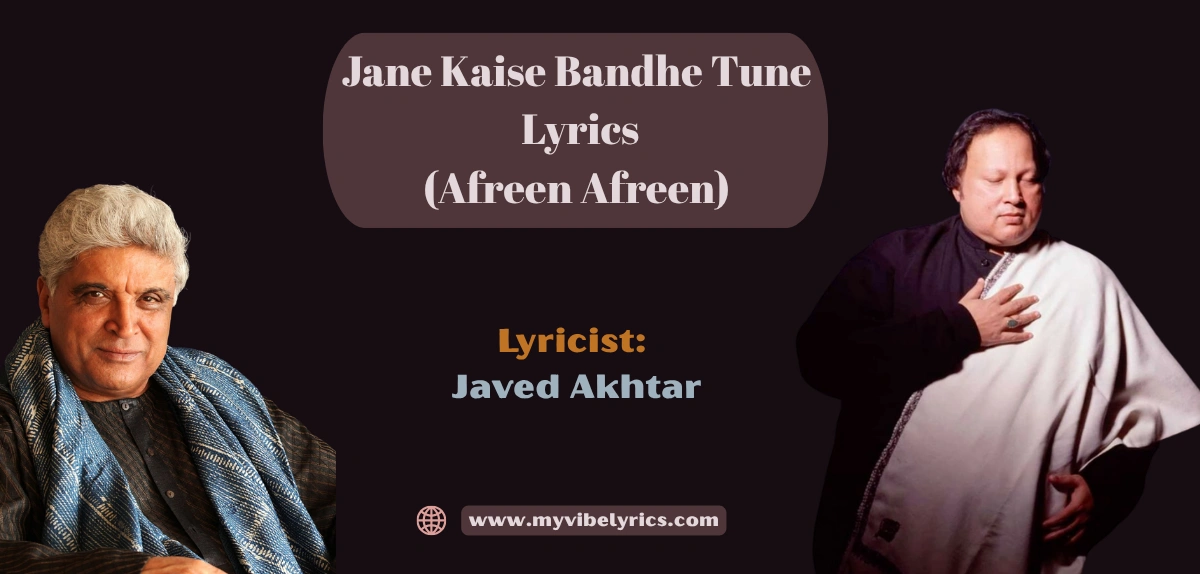
Some songs do not arrive. They pull you. The moment you hear Jane Kaise Bandhe Tune Lyrics for the first time, something shifts. That invisible cord, the one the poet writes about, actually tightens around you. It is hard to explain rationally. Javed Akhtar wrote it that way on purpose.
This is Afreen Afreen, and nearly three decades after it was recorded, it still does exactly what it was built to do.
Disclaimer: The lyrics of Afreen Afreen belong to the original rights holders: Javed Akhtar (lyrics), Nusrat Fateh Ali Khan (original composition), and Saregama HMV (label). The transliterations and English translations provided here are offered solely for educational appreciation and lyrical understanding.
About the Song and Its Creators
| Detail | Information |
|---|---|
| Song Title | Afreen Afreen (आफ़रीं आफ़रीं) |
| Opening Line | Jane Kaise Bandhe Tune Akhiyon Ki Dor |
| Singer (Original) | Ustad Nusrat Fateh Ali Khan |
| Singer (Coke Studio) | Rahat Fateh Ali Khan, Momina Mustehsan |
| Lyricist | Javed Akhtar |
| Composer | Nusrat Fateh Ali Khan / Raju Singh |
| Album | Sangam (1996) |
| Music Label | Saregama HMV |
| Genre | Nazm / Semi-Classical / Sufi-Inspired |
| Language | Hindi / Urdu |
| Coke Studio Season | Season 9 (2016) |
Ustad Nusrat Fateh Ali Khan (13 October 1948 – 16 August 1997) was one of the most extraordinary vocal performers in recorded history. A master of Qawwali, the devotional music of the Sufi tradition, he could hold a single performance at peak intensity for several hours. He extended a family lineage in Qawwali stretching back six centuries and is widely credited with introducing the form to global audiences.
Javed Akhtar, who penned these lyrics, needs no introduction in Hindi cinema and Urdu literature. But what makes his contribution to Afreen Afreen exceptional is restraint. He describes beauty through comparison after comparison, metaphor after metaphor, and yet never once overstates. The entire poem arrives at one conclusion: praise is impossible. The word Afreen itself, from Persian-Urdu, means praise, admiration, or applause to the Creator. When repeated as Afreen Afreen, it functions as an exclamation, something between “breathtaking” and “praise be to whoever made this.”
The original was recorded for the collaborative album Sangam in 1996. Twenty years later, Rahat Fateh Ali Khan (Nusrat’s nephew) and singer Momina Mustehsan reimagined it at a slower, more intimate pace for Coke Studio Season 9, and a new wave of listeners encountered the Jane Kaise Bandhe Tune Lyrics for the first time.
Afreen Afreen Lyrics in Hindi (Transliteration)
Note: The lyrics below are presented in Roman transliteration of the original Hindi/Urdu. The song is structured in three movements.
Movement 1: Jism (The Form)
Aisa dekha nahi khoobsurat koi
Jism jaise Ajanta ki murat koi
Jism jaise nigahon pe jadoo koi
Jism nagma koi, jism khushboo koi
Jism jaise mehakti hui chandni
Jism jaise machalti hui ragini
Jism jaise ke khilta hua ik chaman
Jism jaise ke suraj ki pehli kiran
Jism tarsha hua dilkasho dilnashin
Sandli sandli, marmari marmari
Husn-e-jaana ki tareef mumkin nahi
Husn-e-jaana ki tareef mumkin nahi
Afreen afreen afreen afreen
Tu bhi dekhe agar toh kahe humnashin
Afreen afreen afreen afreen
Husn-e-jaana ki tareef mumkin nahi…
Movement 2: Akhiyon Ki Dor (The Thread of Eyes)
Jane kaise bandhe tune akhiyon ki dor
Mann mera khicha chala aaya teri aor
Mere chehre ki subah, zulfon ki shaam
Mera sab kuch hai piya, ab se tere naam
Nazron ne teri chhua toh hai ye jadoo hua
Hone lagi hoon main haseen
Afreen afreen afreen
Afreen afreen afreen
Afreen afreen afreen
Afreen afreen afreen
Movement 3: Chehra (The Face)
Chehra ik phool ki tarah sharab hai
Chehra uska hai ya koi mehtaab hai
Chehra jaise ghazal, chehra jaane ghazal
Chehra jaise kali, chehra jaise kanwal
Chehra jaise tasavvur bhi tasveer bhi
Chehra ik khaab bhi, chehra tabeer bhi
Chehra koi Alif Laila ki dastan
Chehra ik pal yakeen, chehra ik pal gumaan
Chehra jaisa ke chehra kahin bhi nahi
Mahrooh mahrooh, mehjabin mehjabin
Usne jaana ki tareef mumkin nahi
Usne jaana ki tareef mumkin nahi
Afreen afreen afreen afreen
Tu bhi dekhe agar toh kahe humnashin
Afreen afreen afreen afreen
Usne jaana ki tareef mumkin nahi…
Afreen… Afreen…
Afreen Afreen Lyrics in English Translation
Line-by-line meaning of the Afreen Afreen Lyrics in English, following the same three-movement structure.
Movement 1: The Form
I have never seen anyone this beautiful
A form like the sculptures of Ajanta caves
A form that casts a spell on the eyes
A form that is melody, a form that is fragrance
A form like moonlight carrying its own scent
A form like a restless, swelling melody
A form like a garden in full bloom
A form like the very first ray of the morning sun
A form sculpted with exquisite, soul-captivating grace
Sandalwood-soft, marble-smooth
It is not possible to praise the beauty of the beloved
It is not possible to praise the beauty of the beloved
Afreen afreen afreen afreen
Even if you were to see her, you would say the same, my companion
Afreen afreen afreen afreen
It is not possible to praise the beauty of the beloved…
Movement 2: The Thread of the Eyes
How have you tied this thread from your eyes?
My heart, pulled, came walking toward you
The morning of my face is yours, the evening of your hair is mine
Everything I am, my love, from now on belongs to your name
When your gaze touched me, that was the spell
I began to feel beautiful
Afreen afreen afreen
Afreen afreen afreen
Afreen afreen afreen
Afreen afreen afreen
Movement 3: The Face
A face intoxicating as wine, delicate as a flower
Is that her face, or is it the full moon?
A face that is a ghazal, a face that knows the ghazal
A face like a bud, a face like a lotus
A face that is both imagination and portrait
A face that is a dream and its very interpretation
A face like a tale from One Thousand and One Nights
A face that is certainty one moment, doubt the next
A face unlike any face anywhere
Spellbound, spellbound, exquisitely beautiful, exquisitely beautiful
Even she understood that her praise is not possible
Even she understood that her praise is not possible
Afreen afreen afreen afreen
Even if you were to see her, you would say the same, my companion
Afreen afreen afreen afreen
Even she understood that her praise is not possible…
Afreen… Afreen…
Musical Composition and Vocal Performance: Afreen Afreen Lyrics
The structure of Afreen Afreen is not accidental. Javed Akhtar builds the poem in ascending registers of intimacy.
He begins with the jism, the outermost, most visible aspect of a person. Then he moves to the akhiyon ki dor, the thread of the eyes, which is invisible and internal, the moment attraction becomes connection. Finally he arrives at the chehra, the face, which sits between the outer and the inner, a surface that reveals what words cannot. Each movement escalates what the previous one established. By the time the third Afreen lands, the listener has been walked through the full arc of being overwhelmed.
What Nusrat Fateh Ali Khan does vocally is equally architectural. The original recording carries the energy of a live performance even in its studio form. His phrasing is expansive, each line given breath and weight. The comparative sequences, jism jaise chandni, jism jaise ragini, land as accumulations rather than lists. Listeners do not tick through them. They absorb them.
The Coke Studio version by Rahat Fateh Ali Khan and Momina Mustehsan works differently. It strips the tempo back significantly, and Momina’s voice anchors the second movement, the Jane Kaise Bandhe Tune section, with a fragility that makes the cord of attraction feel far more vulnerable. The two versions are not competing. They illuminate different facets of the same poem.
The Ajanta reference in the first verse is worth pausing on. The Ajanta caves, carved between the 2nd century BCE and 5th century CE, contain some of the most celebrated figural art in the world. When Javed Akhtar uses Ajanta as the measure of physical beauty, he is placing the beloved in conversation with centuries of human reverence for form. That is not a casual simile.
The Alif Laila reference in the third movement does the same for mystery. One Thousand and One Nights is a text that exists precisely because the story must not end, because ending means death. To say a face is like that story is to say it generates wonder endlessly, that familiarity with it never depletes its surprise.
Why the Jane Kaise Bandhe Tune Verse Hits Differently
Among all the sections of the Afreen Afreen Lyrics in Hindi, the Jane Kaise Bandhe Tune verse is the most personal. Every other verse in the poem is written in the third person. The poet observes, catalogs, marvels. But this verse shifts to the first person, and suddenly the speaker is not admiring from a distance. They have been caught.
Mann mera khicha chala aaya teri aor is one of those lines that has no clean English equivalent. It is not “I came to you.” It is “my heart, drawn, came walking.” The self follows. The decision was already made by something beyond the speaker’s will.
And then the speaker says something remarkable: mere chehre ki subah, zulfon ki shaam. The morning of my face, the evening of your hair. Two people, two moments of day, placed together not as opposites but as a natural continuity. Morning becomes evening. One face leads to another. Time itself is reorganized around the beloved.
This is why the Afreen Afreen Lyrics in English are genuinely difficult to translate fully. The Hindi and Urdu versions operate on a compressed poetic logic that requires unpacking without ever feeling compressed when heard.
? FAQs: Afreen Afreen Lyrics
Q: What does “Afreen” mean?
A Persian-Urdu word meaning praise or admiration. As an exclamation, it means “Breathtaking!” or “Praise to her Creator.”
Q: Who wrote the lyrics of Afreen Afreen?
Javed Akhtar, for the 1996 album Sangam.
Q: Is Afreen Afreen a Bollywood song?
No. It is an independent album track from Sangam (1996), not from any film.
Q: What is the meaning of Jane Kaise Bandhe Tune Akhiyon Ki Dor?
“How did you tie this thread from your eyes to my heart?” It describes being pulled involuntarily toward the beloved by a single glance.
Q: What is the difference between the original and the Coke Studio version?
The original (Nusrat Fateh Ali Khan) is energetic and expansive. The Coke Studio version (Rahat Fateh Ali Khan and Momina Mustehsan, 2016) is slower, stripped-down, and more intimate.
Q: Who sang Afreen Afreen in Coke Studio?
Rahat Fateh Ali Khan and Momina Mustehsan, in Season 9 (2016).
Q: Why is the Ajanta reference used in the lyrics?
Ajanta caves are home to ancient masterpieces of Indian sculpture and art. The comparison places the beloved’s beauty on a level of timeless, civilizational reverence.

 If You Liked The Lyrics Of This Song, Be Sure To Check Out These Lyrics As Well:
- Shiv Tandav Stotram Lyrics in English
- Pranamya Shirasa Devam Lyrics
- Shri Swami Samarth Aarti Lyrics
- Durga Saptashloki Lyrics in Tamil
- Aigiri Nandini Lyrics In Sanskrit
- Teri Murli Ki Dhun Sunne Lyrics
- Hara Hu Baba Par Tujhpe Bharosa Hai Lyrics
- Rama Rama Ratte Ratte Biti Re Umariya Lyrics
- Kabhi Fursat Ho To Jagdambe Lyrics
- Om Voices Ya Devi Sarvabhuteshu Lyrics
- Karunamayi Kripa Kijiye Lyrics
- Jode Jode Falwa Lyrics
- Karuna Karo Kasht Haro Gyan Do Bhagwan Lyrics
- Itna Na Mujhse Tu Pyar Badha Lyrics
- Gurpreet Kaur Lakdi Ki Kathi Lyrics