

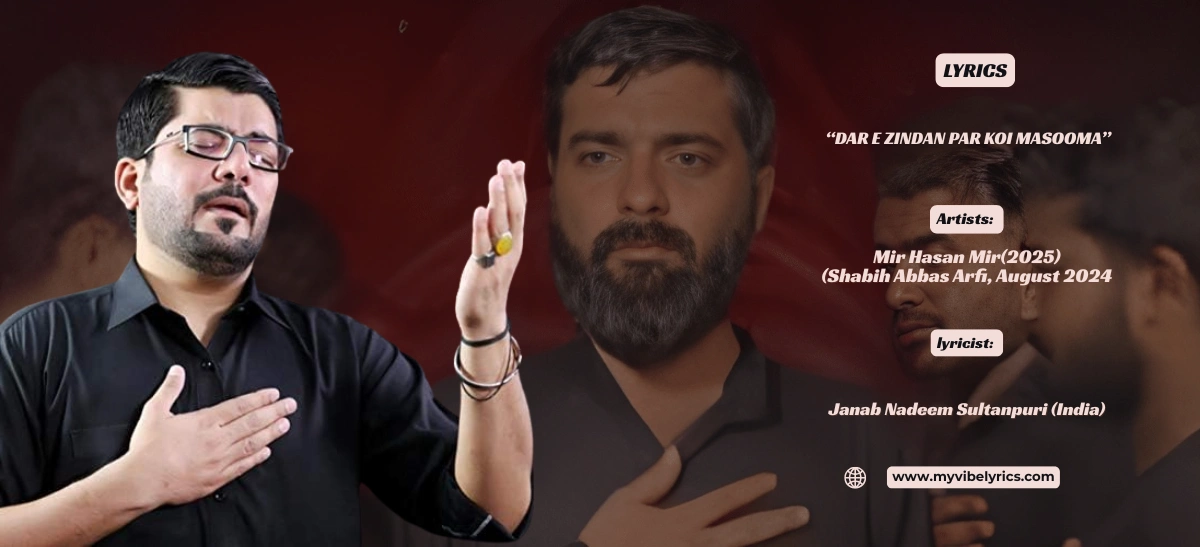
There are nohas you listen to. And then there are nohas that stay with you the kind where a single line makes you stop whatever you are doing. Dar E Zindan Par Koi Masooma Lyrics belongs firmly in the second category. The title alone roughly translating to “At the Gate of the Prison, an Innocent One” carries an unbearable weight even before the first verse begins.
Released as part of Mir Hasan Mir’s Muharram 2025/1446 Hijri noha album dedicated to Bibi Sakina (s.a.), This noha spread rapidly across South Asian and diaspora communities, becoming one of the defining lamentations of the season.
Overview: About the Song and Its Creators
| Detail | Information |
|---|---|
| Song Title | Dar E Zindan Par Koi Masooma |
| Singer / Reciter | Mir Hasan Mir |
| Composer | Janab Nadeem Sultanpuri (India) |
| Lyricist | Janab Nadeem Sultanpuri (India) |
| Original Reciter | Janab Shabih Abbas Arfi |
| Album / EP | Dare Zindan Par Koi Masooma – EP (Shabih Abbas Arfi, August 2024); Mir Hasan Mir version, Muharram 2025 |
| Genre | Noha (Islamic Lamentation) |
| Theme | Grief, Captivity, Spiritual Mourning, Karbala |
| Language | Urdu |
| Subject | Bibi Sakina (s.a.), daughter of Imam Hussain (a.s.) |
Dar E Zindan Par Koi Masooma Lyrics– Urdu Transliteration
All rights belong to the original artists. The following is presented for contextual appreciation and understanding.
Mukhda (Refrain)
Dar e Zindaan par koi masooma
Padha karti hai ye ro kar noha
Baba, Baba, Baba, Baba
Bohat dar mujh ko yahan lagta hai
Bohat tanha hoon, chalay aao na
Verse 1
Khud aa ke dekh lo Baba meri halat
Nahi pehchaan pao ge meri soorat
Sahe bachpan mein masaaib itne
Zaeefa dikhne lagi ye dukhiya
Bada dushwaar hai iss qaid mein jeena
Bohat yaad aa raha hai aap ka seena
Verse 2
Gaye ho jab se nahi soyi main
Sakoon se ab tak kabhi ik lamha
Mujhe phir qabar mein lagne laga hai dar
Nikala tha jinhoon ne lasha-e-Asghar
Woh zalim phir se palat aaye hain
Phuphi aur main hoon yahan phir tanha
Verse 3
Main raon le ke kab tak siskiyaan Baba
Bohat dukhti hain meri pasliyan Baba
Sakina is dam hai kis halat mein
Faqat samjhen gi ye Dadi Zehra
Nazar aata nahi aankhon ko malti hoon
Sahara le ke deewaron ka chalti hoon
Pakad kar zulfein mujhe zalim ne
Na jaane kaisa tamacha mara
Verse 4
Mere rukhsaar zakhmi, kaan zakhmi hain
Hai zakhmi pusht aur dandaan zakhmi hai
Mujhe is tarah kiya hai zakhmi
Badan se chipka hai mera kurta
Verse 5
Lage hain zakhm jitne sab dikhaungi
Jab aaoge to main sab kuch bataungi
Bahut maara hai, bahut tadpaaya
Mujhe logon ne samajh kar tanha
Maqta (Closing Couplet)
Nadeem, uss waqt khud zindaan rota tha
Sakina jis ghadi padhti thi ye noha
Mujhe lagta hai ke ab ghut ghut kar
Nikal jaaye ga yahin dam mera
Dar e Zindaan par koi masooma
Padha karti hai ye ro kar noha
Baba, Baba, Baba, Baba
Dar E Zindan Par Koi Masooma Lyrics In English
Refrain
At the gate of the prison, an innocent child
Recites this lament, weeping aloud
Oh father, oh father, oh father, oh father
I am so frightened here
I am so alone — please come
Verse 1
Come yourself and see the state I am in, father
You would not recognise my face anymore
I have endured such calamities in childhood
This grieving child has begun to look aged
It is so difficult to live in this captivity
I miss the warmth of your chest so deeply
Verse 2
Since you left, I have not slept
Not a single moment of peace
I have again begun to fear the grave
Of those who removed the body of Asghar
Those oppressors have returned again
My aunt and I are alone here once more
Verse 3
How long can I keep weeping with these sobs, father?
My ribs are in so much pain, father
What state Sakina is in at this moment
Only my grandmother Zahra could truly understand
My vision fails I keep rubbing my eyes
I walk only by using the walls for support
The oppressor grabbed me by my hair
And struck me with a slap I cannot even describe
Verse 4
My cheeks are wounded, my ears are wounded
My back is wounded, my teeth are broken
I have been so badly injured
That my own tunic now clings to my body
Verse 5
Every wound I carry, I will show you
When you come, I will tell you everything
They beat me so much, they tormented me so much
These people, finding me all alone
Closing Couplet
Nadeem, the very prison wept at that moment
When Sakina recited this lament
I feel as though, from this constant suffocation
My life will slip away right here
At the gate of the prison, an innocent child
Recites this lament, weeping aloud
Oh father, oh father, oh father, oh father
Disclaimer
The lyrical content discussed in this post belongs entirely to the original artists Nadeem Sultanpuri (lyricist and composer), Mir Hasan Mir (reciter, 2025 version), and Shabih Abbas Arfi (original reciter). All content is referenced solely for appreciation, educational context, and devotional understanding. Please support the artists by streaming the original track on YouTube, SoundCloud, and Apple Music. This blog claims no ownership over the creative work.
Musical Composition and Vocal Performance
The Arrangement
The composition by Nadeem Sultanpuri is deliberately sparse. There is minimal instrumentation the emotional architecture of the noha rests almost entirely on vocal dynamics and the weight of the words. This is not a limitation; it is a conscious and brilliant structural choice. Anything more elaborate would compete with the imagery. As it stands, there is nothing to hide behind.
The noha opens with the refrain functioning almost like a title card a scene-setter that announces the tragedy before inhabiting it. “At the gate of the prison, an innocent child recites this lament.” This technique of narrating before speaking in first person is classical in Urdu marsiya tradition, and Sultanpuri deploys it with full command.
Mir Hasan Mir’s Vocal Delivery
What Mir Hasan Mir does with this text goes beyond recitation. The recurring “Baba, Baba, Baba, Baba” is not ornamental. In his delivery, each repetition carries a different emotional weight the first is calling, the second is pleading, the third is fading, and the fourth is the near-silence of someone who has stopped expecting an answer.
The fusion of plaintive vocals with evocative verses makes the piece an unyielding testament of mourning within the cultural context of Karbala.
The Maqta’s Genius
The closing couplet where Nadeem Sultanpuri inserts his own takhallus (pen name) is a moment of breathtaking literary honesty. The poet steps briefly outside Sakina’s voice to say: “Even the prison wept when she recited this.” It is simultaneously a tribute and an admission that no human can fully contain this grief, not even the poet himself.
The lyricist’s final lines expressing that Sakina’s lament would cause his own life to slip away from suffocation carry the full force of a tradition spanning over fourteen centuries of Karbala mourning.
? FAQs About Dar E Zindan Par Koi Masooma Lyrics
Q: Who originally recited Dare Zindan Par Koi Masooma Lyrics?
The noha was originally recited by Janab Shabih Abbas Arfi. The original EP, titled Dare Zindan Par Koi Masooma, was composed by Shabih Abbas Arfi with lyrics by Nadeem Sultanpuri and arrangement by HDS Studio. Shazam The Mir Hasan Mir version was released for Muharram 2025/1447.
Q: Who wrote the lyrics of Dar E Zindan Par Koi Masooma?
Both the composition and lyrics are credited to Janab Nadeem Sultanpuri of India.
Q: What does the title mean in English?
It translates to “At the gate of the prison, an innocent one” — referring to Bibi Sakina (s.a.), imprisoned after the tragedy of Karbala.
Q: Is this noha about Bibi Sakina or Bibi Zainab?
The noha is narrated from Bibi Sakina’s perspective. Bibi Zainab, referred to as Phuphi (paternal aunt), is mentioned within the verses as a fellow captive.
Q: When was the Mir Hasan Mir version released?
The Mir Hasan Mir version was released in June–July 2025 as part of his Muharram 2025/1447 noha series.
Q: Where can I listen to this noha?
The Mir Hasan Mir version is available on YouTube on his official channel. The Shabih Abbas Arfi original is on Apple Music as part of the Dare Zindan Par Koi Masooma EP, released August 2024.
Q: What is a noha?
A noha (نوحہ) is an Islamic lamentation most commonly associated with Shia mourning traditions during Muharram. It is a structured poetic form commemorating the tragedy of Karbala, recited during Majlis gatherings.

 If You Liked The Lyrics Of This Songs, Check Out Also These Lyrics As Well:
- Biba Sada Dil Mod De Lyrics
- Tenu Sang Rakhna Lyrics
- Hariharan Aarti Kunj Bihari Ki Lyrics
- Main Rahoon Ya Na Rahoon Lyrics
- Kaise Bataye Kyun Tujhko Chahe Lyrics
- Shreya Ghoshal Chikni Chameli Lyrics
- Main Rang Sharbaton Ka Lyrics
- Tere Hawale Kar Diya Lyrics
- Aankhein Khuli Ho Ya Ho Band Lyrics
- Unke Andaz e Karam Lyrics
- shqa Ve Chadeya Lyrics
- Predador De Perereca Lyrics English
- Tenu Takiya Bina Ni Dil Rajda Lyrics
- Lakhbir Singh Lakha Keejo Kesari Ke Laal Lyrics
- Krsna Hola Amigo Lyrics
- Ek Khatola Jail Ke Bhitar Lyrics
- Guzarishein Samar Jafri Lyrics