

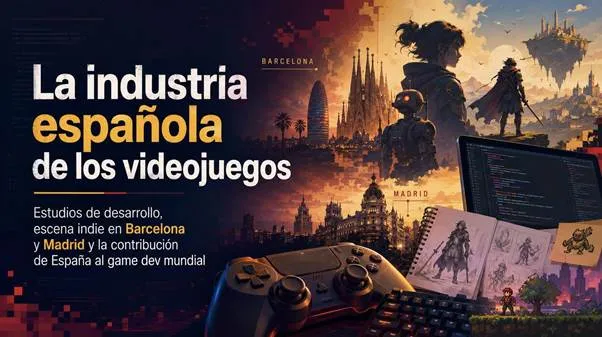
Over the past two decades, Spain has quietly become one of Europe’s most vibrant creative forces in video game development. What began in the 1980s with the so-called «golden age» of Spanish software — producing cult classics such as La Abadía del Crimen and the legendary football manager PC Fútbol — has matured into a robust industry that now generates around 1.46 billion euros in annual revenue and employs more than 10,500 professionals, according to the latest White Book of Spanish Video Game Development. The sector may no longer grow at the double-digit rates seen before the pandemic, but its resilience in a turbulent global market is remarkable.
That growth is fueled by an enormous domestic audience: Spain counts more than 22 million players, and gaming has firmly established itself as one of the country’s favorite forms of entertainment. For anyone who wants to follow the latest releases, studios, and industry news, specialized outlets such as Jugador Español reflect the growing appetite of Spanish audiences for digital play. This combination of passionate players and daring creators has turned the Iberian peninsula into fertile ground for developers, designers, and programmers alike.
Studios That Set the Pace
Spain’s development map is dotted with names that command international respect. MercurySteam, based in Madrid, rose from the ashes of the pioneering studio Rebel Act and went on to reinvent legendary Japanese franchises. Its Castlevania: Lords of Shadow trilogy marked the first time a Western studio was entrusted with Konami’s iconic saga, and its collaboration with Nintendo on Metroid Dread proved that a Spanish team could deliver AAA-quality experiences celebrated by critics and players worldwide.
In Seville, The Game Kitchen achieved global success with Blasphemous, a metroidvania whose exquisite pixel art draws on Spanish Baroque imagery and Holy Week iconography. Funded on Kickstarter in a matter of hours, the game went on to sell more than 2.5 million copies, spawning a sequel and cementing the studio’s reputation for combining tight gameplay with a distinctive artistic identity. Madrid’s Tequila Works, meanwhile, earned acclaim for the emotionally resonant RiME and later partnered with Riot Games on Song of Nunu, a narrative adventure set in the League of Legends universe. These flagship studios are joined by a long list of talent spread across the entire country.
Barcelona, Madrid, and the Indie Scene
If large studios provide the headlines, the independent scene is the true creative heart of the industry. Catalonia alone concentrates roughly 31% of all Spanish studios and accounts for more than half of the sector’s total revenue, making it the undisputed engine of national development. Barcelona is home to Nomada Studio, creators of Gris, a visually stunning platformer about grief and healing that became a worldwide reference point for games as art. The city’s mix of design schools, international talent, and mobile-focused companies like Digital Legends has made it a magnet for creative professionals.
Madrid is the other great pole, hosting around a quarter of the country’s studios and a dense network of established developers and newcomers. Beyond these two hubs, Andalusia and the Valencian Community also contribute bold, original projects — from Digital Sun’s inventive shopkeeper-adventure Moonlighter to Deconstructeam’s thought-provoking narrative titles such as The Red Strings Club and Gods Will Be Watching. The workforce is notably young and dynamic: roughly 90% of employees are under 45, giving the ecosystem an energy and willingness to take creative risks that larger, more conservative markets often lack.
Spain’s Contribution to Global Game Development
Spanish studios increasingly build for the world rather than just the home market. More than half of the industry’s revenue now comes from abroad, with North America and the rest of Europe as the leading destinations for exported titles. This makes video games one of Spain’s most outward-facing cultural industries, capable of generating significant value well beyond national borders. The «made in Spain» label has come to signal a strong visual identity, carefully crafted storytelling, and a willingness to tackle complex themes — grief, addiction, religion, moral choice — that many bigger productions shy away from.
The country’s influence also extends to technology and talent. Spanish developers have contributed advances in graphics tooling, virtual and augmented reality, and development pipelines, while a growing network of specialized universities and schools steadily feeds fresh talent into the pipeline. Programmers, artists, and designers trained in Spain now work at top studios both at home and across the global industry.
Challenges Ahead
For all its creativity, the sector faces real structural challenges. The vast majority of studios are small companies — more than half bill under 200,000 euros a year — while a tiny fraction of large firms concentrates the bulk of total revenue. Industry associations continue to call for tax incentives, public funding, and a stronger domestic publishing and investment ecosystem to help promising indie teams scale into mid-sized and large enterprises. Access to financing, adaptation to new technologies, and reliance on foreign investors remain pressing concerns.
Still, the trajectory is unmistakable. In just a couple of decades, Spain has evolved from a peripheral player into a genuine creative reference in global game development. With ever more ambitious projects, an internationally recognized artistic voice, and a new generation of developers eager to push boundaries, the Spanish video game industry looks poised to keep punching well above its weight on the world stage.