

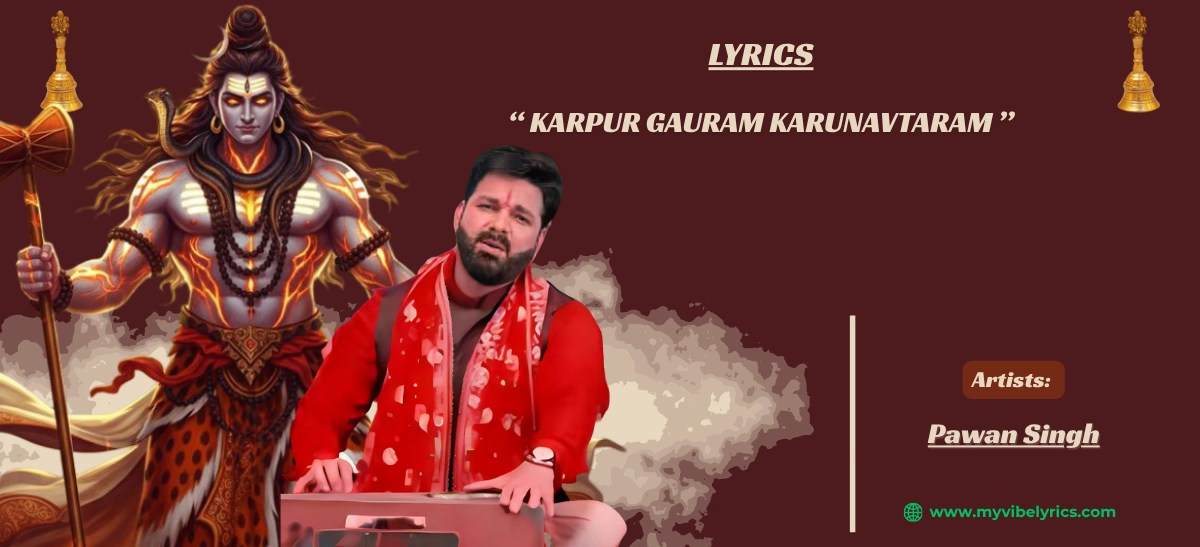
“Pawan Singh Karpur Gauram Karunavtaram lyrics” have touched the hearts of millions, blending ancient Sanskrit devotion with the powerful voice of one of Bhojpuri cinema’s most celebrated singers. In this spiritually uplifting bhajan, Pawan Singh brings to life the revered Shiva Stotra, traditionally chanted during aarti and meditation. His rendition infuses timeless verses with raw emotion, invoking divine energy and inner peace.
This devotional track not only showcases Pawan Singh’s vocal depth but also reflects the sacred power of the “Karpur Gauram Karunavtaram” mantra — a prayer that praises Lord Shiva as the embodiment of purity, compassion, and universal presence. Whether you’re seeking spiritual solace or musical serenity, these lyrics serve as both a prayer and a poetic masterpiece.
In this post, we present the full lyrics in Hindi, transliteration in English, and meaning , along with insights into the song’s spiritual tone and musical brilliance.
Overview: About The Song “Karpur Gauram Karunavtaram”
| Aspect | Details |
|---|---|
| Song Title | Karpur Gauram Karunavtaram |
| Singer | Pawan Singh |
| Composer | Vinay Bihari |
| Lyricist | Vinay Bihari (based on traditional Sanskrit shloka) |
| Album | Maai De Da Chunariya Ke Chhaanv |
| Genre | Bhojpuri Devotional Bhajan |
Pawan Singh Karpur Gauram Karunavtaram Lyrics in Hindi
Karpur Gauram Karunavataram
Sansar Saram Bhujagendraharam
Sada Vasantam Hridayaravinde
Bhavam Bhavani Sahitam Namami
Nishumbha Shumbha Mardini
Prachanda Mund Khandini
Vane Rane Prakashini
Bhajami Vindhyavasinim
Bhajami Vindhyavasinim
Bhajami Vindhyavasinim
Trishula Munda Dharinim
Dhara Vigha Harinim
Grihe Grihe Nivasinim
Bhajami Vindhyavasinim
Bhajami Vindhyavasinim
Bhajami Vindhyavasinim
Daridra Dukh Harinim
Sada Vibhuti Karinim
Viyoga Shoka Harinim
Bhajami Vindhyavasinim
Bhajami Vindhyavasinim
Bhajami Vindhyavasinim
Lasat Sulochanah
Latasanam Varapradam
Kapala Shoola Dharinim
Bhajami Vindhyavasinim
Bhajami Vindhyavasinim
Bhajami Vindhyavasinim
Srishti Ke Raksha La Tu
Lakho Roop Dhailu
Dharmi Ke Dharam Tuhi Maiya Bachailu
Srishti Ke Raksha La Tu
Lakho Roop Dhailu
Dharmi Ke Dharam Tuhi Maiya Bachailu
Dharmi Ke Dharam Tuhi Maiya Bachailu
Gun Gaan Tohar Kare Bhole Shankar
Sheesh Jhukave Srishti Ke Swami
Sada Vasantam Hridayaravinde
Bhavam Bhavani Sahitam Namami
Karpur Gauram Karunavataram
Sansar Saram Bhujagendraharam
Karabja Dana Dadharam
Shivam Shivapradayinim
Vara Varananam Shubham
Bhajami Vindhyavasinim
Bhajami Vindhyavasinim
Bhajami Vindhyavasinim
Kapeendra Jaminipradam
Tridha Swaroop Dharinim
Jale Sthale Nivasinim
Bhajami Vindhyavasinim
Bhajami Vindhyavasinim
Bhajami Vindhyavasinim
Vishishta Shishta Karinim
Vishala Roop Dharinim
Mahodare Vilasinim
Bhajami Vindhyavasinim
Bhajami Vindhyavasinim
Bhajami Vindhyavasinim
Purandaradi Sevitam
Puraadi Vansha Khanditam
Vishuddha Buddhikarinim
Bhajami Vindhyavasinim
Bhajami Vindhyavasinim
Bhajami Vindhyavasinim
Vinay Bihari Pawan Gavele Bhajaniya
Mahima Se Bharal Mai Tohar Ba Charaniya
Vinay Bihari Pawan Gavele Bhajaniya
Mahima Se Bharal Mai Tohar Ba Charaniya
Mahima Se Bharal Mai Tohar Ba Charaniya
Charaniya Ke Dhuriya Tohar Lagela Chandan
Umar Bhar Kare Mann Kari Hum Gulami
Sada Vasantam Hridayaravinde
Bhavam Bhavani Sahitam Namami
Karpur Gauram Karunavataram
Sansar Saram Bhujagendraharam
Pawan Singh Karpur Gauram Karunavtaram Lyrics in English Translation
Pure (white) like camphor, the embodied compassion,
The very essence of worldly existence, wearing the serpent‑garland,
Forever residing in the lotus of my heart,
I bow to (you) along with Bhavani (the Divine Mother).
You who quell demons Nishumbha and Shumbha,
You who strike down fierce skull and dismemberers,
You who illuminate forest and battlefield alike,
I worship You, O Vindhyavasini (Goddess of Vindhya).
You who bear the trident and the severed head,
You who tear asunder suffering and obstacle,
Infinite in dwelling in every house and place,
I worship You, Vindhyavasini.
You who take away misery and poverty,
Ever doer of divine grace, remover of sorrow,
You who dispel separation and grief,
I worship You, Vindhyavasini.
Your eyes shining like molten flame,
Your posture graceful, bestower of boons,
You who bear skulls and trident,
I worship You, Vindhyavasini.
For the protection of creation, you assumed countless forms,
To preserve dharma you came as Mother,
To safeguard the cosmic order you became manifest,
I worship You, outstanding Lord and Mother.
All praise is sung to you, O BholeShankar (innocent Lord Shiva),
Even the Lord of creation bows his head,
Forever dwelling in the lotus heart,
I bow to You along with Divine Mother.
You who grant boons to Shiva,
You who grant auspiciousness to all faces,
You who give the earth and skies dwelling,
I worship You, Vindhyavasini.
You who nurture in three modes of being,
You who reside in water and land,
You who act in special and proper ways,
I worship You, Vindhyavasini.
You whose form is vast,
You who play in the cosmic sea,
I worship You, Vindhyavasini.
You who are worshipped by Purandar and others,
You who broke dynasties of demons,
You who endowed pure intellect,
I worship You, Vindhyavasini.
Vinay Bihari and Pawan sing your praises,
O Mother, your glory fills the world, O your feet,
Vinay Bihari and Pawan sing your praises,
O Mother, your glory fills the world, O your feet,
Your feet are sandalwood‑like, my mind desires your servitude,
For a lifetime I vow my devotion,
Forever dwelling in the lotus heart,
I bow to You along with Bhavani.
Pure like camphor, embodiment of mercy,
You who are essence of the world, wearing the serpent‑garland.
🕉️ Karpur Gauram Karunavtaram Meaning and Pronunciation :
-
“Karpur” is pronounced like kar-poor (meaning camphor).
-
“Bhujagendraharam” means “He who wears the serpent king as a garland” (bhujag = snake, indra = king, haram = garland).
-
“Vindhyavasinim” refers to the Goddess residing in the Vindhya mountains.
-
“Namami” means “I bow down” or “I offer salutations.”
| Sanskrit | Transliteration | Meaning |
|---|---|---|
| कर्पूरगौरं | Karpūr Gauram | White like camphor (symbol of purity) |
| करुणावतारं | Karuṇā Avatāram | Embodiment of compassion |
You Might Also Love These Lyrics :
- Kannana Kanne Song Lyrics
- Rashed Al-Majed’s Kethr El Seneen Lyrics
- Ilaiyaraaja Raja Raja Chozhan Lyrics
- Ye Dosti Hum Nahi Todenge Lyrics
- Manasilayo Song Lyrics
Disclaimer: Lyrics and translations are sourced directly from traditional Vedic texts and verified music platforms like JioSaavn and Gaana, ensuring 100% authenticity. This post honors the song’s cultural and spiritual significance without alteration. For personal or commercial use, respect copyright held by the album’s label.
FAQ (Common Questions)
Q1. What is the origin of the Karpur Gauram mantra?
A: The phrase Karpur Gauram Karunavtaram … is part of a recensional form of the Shiva Yajur mantra / hymn historically used in aarti and ritual worship of Shiva. Many temples recite it at the end of aarti.
Q2. What is the deeper meaning of “Bhujagendraharam”?
A: Bhujagendraharam literally means “wearer of the king of serpents as garland” (i.e. the serpent king). It symbolizes mastery over death, poisons, the cycle of life and death, and the coiling energy (kundalini) in spiritual metaphor.
Q3. Why is Shiva described as residing in the lotus of the heart (hridayāravinde)?
A: This is a common spiritual metaphor: the lotus (which remains unstained by the mud) represents purity, and “lotus of the heart” refers to the spiritual core of a devotee. It suggests that the divine is not distant but dwells within the purified inner being.
Q4. Why does the song invoke Vindhyavasini?
A: Vindhyavasini is a traditional goddess associated with the Vindhya hills (often a form of Shakti). Here, the lyricist merges the veneration of Shiva and Shakti, presenting the divine in a unified form. The devotional tradition of many Hindu bhajans often marries masculine and feminine divine aspects.
Q5. Can one chant this song as a prayer / meditation?
A: Yes. Because the opening mantra is sacred and the rest is devotional praise, many listeners already use “Karpur Gauram Karunavtaram” as part of their Shiva aarti or prayer rituals. The full song’s verses deepen that invocation and can be used in meditative singing or group bhajan sessions.
